The Blessings of Beer
...

It was an odd gathering—a judge, resplendent in a dark robe and horsehair wig, and two men in wheelchairs. There, amid blaring car horns and curious onlookers, the party conducted judicial proceedings in the open-air car park. This was because the court of law, much like dozens across the country, was not accessible to persons with disabilities (PWDs). Fixed seats, narrow corridors, sidewalks and out-of service elevators (where they even exist), prevent PWDs from accessing public services to which they are entitled.
It is a familiar scene found at nearly every building in Nairobi. And according to the 2008 Kenya National Survey for Persons with Disabilities (KNSPD) Preliminary Report, this is what nearly two million people in Kenya experience every day. People like Francis Mutegi, a mid-30s broadcast journalist with a golden voice. The newlywed father of one has been using assistive devices from an early age and is now on crutches.
He says, “If the steps of a building are not on the same level as the entry point, it can be really difficult to manoeuvre your way in. And even when you do get in, some of the buildings were not constructed with those who walk on fours (using wheelchairs and crutches) in mind.” Mutegi speaks of staircase steps that are too close together. This, he explains, denies a person on crutches the chance to pause and gather energy before taking the next step. “Even in times of an emergency, a disabled person has to slowly make their way down the stairs,” he shares.
And the government itself has been moving at an excruciating slow pace when it comes to passing the relevant legislature to solve accessibility. Emblematic of this is the group of protesters with disabilities who camped outside State House in 1964. They were seeking audience with the then-Prime Minister, Mzee Jomo Kenyatta. Thirty-nine years later, the 2003 Persons with Disabilities Act was enacted.
The act established the National Council for Persons with Disabilities (NCPWD) to help achieve equal opportunities for persons with disabilities in every aspect of public and private life. Of note is Section 22 that stipulates in part (1) “a proprietor of a public building shall adapt it to suit persons with disabilities in such manner as may be specified by the Council.” (2) “All proprietors of public buildings shall comply with subsection (1) within five years after this section comes into operation.” 2012 makes it nine years since the act was passed (and four since the directives in Section 22 lapsed).
When UP conducted an informal survey of popular public buildings, we found a piecemeal approach was being applied. Select number of buildings at City Hall had ramps; the ramp at the Supreme Court of Kenya was located a long distance from the main entrance; and the University of Nairobi had working lifts, though some were in deplorable states. Meanwhile, the Central Police Station had neither a ramp nor handrail in sight. But whose responsibility is it to crack the whip, anyway?
Essentially it is the responsibility of NCPWD. It is up to this government body to inspect public buildings and make sure they comply with the standards. But their reach is fairly limited. “[There’s a] lack of an enforcement framework to make sure the provisions within the Disability Act 2003, the Constitutions and indicators in the [Performance Contracts of all Ministries, State Corporations, Local Authorities and tertiary institutions] are implemented and enforced,” posits Mr. Isaac Manyonge, Disability Mainstreaming Advisor, NCPWD.
“Mainstreaming” ensures that disability issues are made an integral part in the policy formulation, design, planning, implementation, monitoring and evaluation of both public and private organization programs. Thus it falls on this department to carry out accessibility audits to find out whether public institutions have accessible service points to PWDs. The lack of action on the part of the body comes down to cost (read: the government doesn't make PWDs a budgetary priority).
Though Mr. Manyonge argues that “It’s very expensive to install elevators that have audio, visual and tactile components. Most institutions take Disability Mainstreaming as a ‘by the way’ component, only to awaken when one of their own graduates to disability.” Lucas Keya, Kenya Paraplegic Organization (KPO) Program Officer echoes these sentiments. He says, “It is expensive to effect these changes. Reconstruction has to accommodate the unique needs of the disabled and account for architectural shortcomings. [It also] interferes with the original design of buildings.
“Imagine if you take an old building and attempt to install an elevator? It would be severely compromised. Sometimes it is not possible,” adds Keya. But there are those who have taken up the challenge. Keya points to an attitude shift within the private sector. He singles out partnerships with Safaricom and Sameer Group that have led these companies to make their work environments handicap-friendly zones by simple acts such as installing ramps at the buildings’ access points.
What of the attitudes of the general populace? Are they handicap-friendly? “[Disabled] people who mostly use matatus often suffer a lot. Getting to a bus station is an issue in the first place. But then you find that the conductors don’t want to admit you because they see you as a bother. The seating arrangements are also not favorable, especially if a person does not have leg joints,” says Mutegi. That’s why, after much sweat and toil, Mutegi managed to purchase a vehicle because “life becomes almost unbearable without it.”
But Mutegi is now part of another statistic. In a city of nearly two million PWDs, there are only 22 parking spaces in the CBD and 70 at major shopping malls across the city demarcated for the disabled. This begs the question: Why is Nairobi handicap unfriendly? “For the time I have been in ‘Mainstreaming’, willingness has not been an issue. However, prioritization has been the problem,” ventures Manyonge.
Commendably, the department has achieved some measure of success. They’ve developed Disability Mainstreaming Policies together with the Ministry of Roads that cater for that ministry, as well as for Kenya Rural Roads Authority, Kenya Urban Roads Authority and Kenya National Highways Authority. “The Thika Super Highway is an example of flyovers that have both ramps and stairs,” he says. But more needs to be done across the board. One can only hope that the KES 268.1 billion, set aside for infrastructure development in the 2012/2013 KES 1.45 trillion budget, will finally affect some of the changes needed. And perhaps allow all PWDs to have their day in court.


"If you combine the spirit, the consciousness, the body and the mind to become one unified body, you can make it.” These are the words of Gilbert Koech, the husband and coach of the Kenyan long-distance runner Edna Kiplagat. "Gun to Tape" is a riveting, 48-minute long documentary that follows athletes Edna and David Rudisha on their journey to the 2012 London Olympics.

Nigerian author, Lola Shoneyin is an accomplished poet, novelist who just recently retired from a teaching position at a secondary school in Abuja. Her debut novel, “The Secret Lives of Baba Segi's Wives” was longlisted for the 2011 Orange Prize and won both the 2011 PEN Oakland Josephine Miles Literary Award and two Association of Nigerian Authors Awards. Lola was among the writers, poets and great thinkers expected at the just concluded StoryMoja Hay Festival.
Why is it important for you to share your daydreams and ideas with the rest of the world?
Culturally, Africans are very secretive. Family secrets must remain hidden, even when it's beyond everyone's control. Sickness, mental health, misfortune must be kept a secret because of the stigma attached. In the same way, we also don't talk about our mistakes. We don't own up and take responsibility for them so sometimes it seems like we're caught in a cycle of self-loathing and self-pity. I ask myself why I write the poems I write sometimes. Then I realise that I'm writing them for my many children, biological and informally- adopted. I write about the things they ought to understand, in first person so they're believable. I want them to know all my truths.
Did you have an “aha moment” when you knew that this (creative writing) was something that you were good at and could pursue seriously?
Not really. I tend to do things because I feel I must, rather than doing them because I'm good at them. I was lucky to have gone to schools where writing was greatly encouraged. I've always written, although I didn't think I'd necessarily become a writer. It was always been a way of relieving tension for me.
You’ve found success with both poetry as well as adult novels and children’s books, in which genre do you feel most expressive and why?
I'm at my most honest when I'm writing poetry because I can hide behind the poet persona. This is not to say that all my poetry is autobiographical. I take on other people's experiences and make them my own.
People say my humorous side is revealed in my fiction. Do your “other lives” (mother, wife, teacher) inform your creative spark? How so?
Yes, absolutely. Especially in my experience as a daughter! This has been the most complex aspect of my existence. Being a good writer has a lot to do with how good an observer you are: how well you listen, what you see and how you process what you see...
Is this your first trip to Nairobi?
No, I passed through in 1999 on my way to the Zimbabwe Book Fair. The guys at Immigration took one look at my Nigerian passport and decided I should be contained within the four walls of the airport. I wanted to breathe Kenya air and look at a good number of Kenyan faces, even if for a few hours only. I was saddened at the time because the airport was buzzing with British tourists. They had no problems at all.
What are your expectations for the festival?
I'm a teacher so I'm really looking forward to doing poetry workshops with children. I love the purity and innocence with which children approach poetry. I'm also looking forward to meeting other wonderful authors and poets. Being invited to the Hay Storymoja festival is a real luxury for me. Apart from raising my four children, I've always had a full-time job. I haven't had the chance to attend festivals or literary events to promote my work. However, I resigned a few months ago and I've had some time on my hands. I've decided to take a year out to focus on my creativity.
Will you conduct a workshop or give a talk at the Hay? If so, what should your fans (new and old) look forward to?
I will be giving several talks and doing a poetry workshop with children. My fans should look forward to openness and honesty. Let's not forget my incredible sense of humour...and my modesty!
Is the global literary culture on the decline or rise?
It depends where you are. In many African countries, literature has become a luxury, something that only people with disposable income can engage with passionately. This is a terrible shame.
Does the author still have a place in society?
If she/he wants to have a place, I see no reason why not. In terms of having a role? Absolutely. To be able to feed minds is a wonderful gift...very powerful. Having said this, the number of people who can access is shrinking. People can't afford books. Those who can afford books have very little time for reading. What words of encouragement would you give budding writers? Don't be afraid to experience life to the fullest. Taste new food, fall in love, touch different fabrics, study animals etc. All these things will enrich your writing. Also, identify what sort of writing you like. Mostly, I read what I like and write what I like.
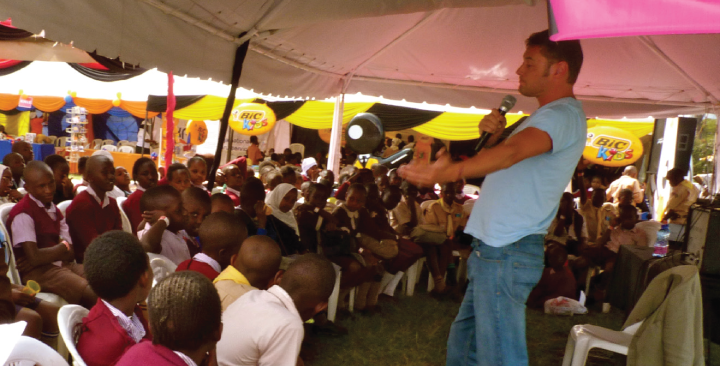
How often does one get to meet Ben Okri, the Booker Prize-winning novelist and poet from Nigeria? The short answer is “Hardly ever.” What of Hari Kunzru, winner of both the British Book and Somerset Maugham awards? Yusef Komunyakaa, the Pulitzer Prizewinning American poet with a prolific repertoire? How about storyteller, poet and New York Times bestselling author Beth Lisick? Short of using Photoshop to insert yourself into the company of one of these accomplished scribes, it rarely happens.
And yet, it has. The 2011 StoryMoja Hay Festival team brought Ben, Hari, Yusef, Beth, and a plethora of local and international illustrators, poets and writers within shouting distance of an attentive audience. And they’re going to work their magic again. With the fourth edition of StoryMoja comes a new venue, the National Museums of Kenya. Utilizing every square inch of the sponsor’s vast cultural space, you can expect to attend workshops and lively lectures in rooms teeming with the world’s history. The best part: A festival ticket also includes free access to the museum’s offerings, from taxidermy and science to artistic creations.
(And don’t forget—free access to the snake park too!) The heart and soul of the festival remains literary enlightenment. And to that end, an impressive selection of over 60 local and international poets, writers, artists and thinkers are expected. One such guest is Lola Shoneyin, winner of the Association of Nigerian Authors’ Awards. Her background as an educator has her excited about the prospect of working with young minds. “I’m a teacher, so I’m really looking forward to doing poetry workshops with children.
I love the purity and innocence with which children approach poetry,” says Lola. 2011 Caine Prize winner, NoViolet Bulawayo, is bracing herself to be blown away at every level. She states, “I’m especially looking forward to meeting great writers and thinkers, to insightful discussions, music, fun, just the whole Why You Must Attend StoryMoja Hay Festival FESTIVAL By Wanjeri Gakuru shebang.” Worthy of note as well is the plan to launch laudable homegrown initiatives at the festival. One such venture is the inaugural Wangari Maathai Memorial Lecture, expected to be delivered by a surprise guest (rumour has it that both Arundhati Roy and Angelique Kidjo have been approached for this honour.) Another interesting project is “Africa’s Wildest Stories”, the brainchild of Paula Kahumbu at Wildlife Direct.
This audio/video series utilizes the power of storytelling to help preserve wildlife. By tapping into the real-life experiences of elders from different cultural communities, “Africa’s Wildest Stories” unearths stories of bravery, mysticism and symbiosis that have connected human beings and wild creatures for centuries. The UP Lounge will also make an appearance again. This year, we’ll offer writers’ workshops facilitated by our editorial team.
Look out for a discussion on unleashing creative energy with consultant Ross van Horn, as well as DJ sets by our in-house “spin master”. And make sure to participate in our fun open call for illustrators that will be going on at our tent throughout the festival. The 2012 StoryMoja Hay Festival (September 13th to 16th) will be held at the National Museums of Kenya. You can find the festival program at www. storymojahayfestival.com. Read interviews with NoViolet Bulawayo and Lola Shoneyin in full at www.upnairobi.com.
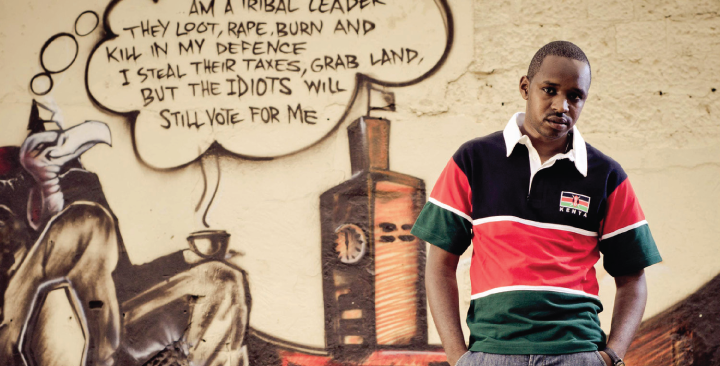
Boniface Mwangi, 29, has a life that makes for a fascinating tale. A primary-school dropout, he has gone on to achieve a lot for both himself and our country. Among a plethora of accolades, Boniface was named the 2008 CNN Multichoice African Journalist of the Year. That same year, he founded Picha Mtaani, a travelling exhibition on post-election violence, and set up PAWA254, which serves as a creative hub.
In 2012, Boniface came up with a controversial graffiti campaign dubbed “Vulture Graffiti”. His group of graffiti artists produced huge murals, depicting various Kenyan politicians with the bodies of vultures. Dressed in black hoodies with a vulture on the back crossed out with a red X, they roamed Nairobi’s streets to manifest their protest. It captured the imagination of the nation (and beyond), provoking Kenya into thinking more about its leaders. “Kenyans are interested in the campaign because we communicate with them. The language that we use.
The depiction on the wall is targeting everyone, even the illiterate. The visual is our great strength,” enthuses Boniface. Unfortunately, intimidation from the government through the City Council of Nairobi forced Boniface and the artists into a corner. Council workers would paint over any work done during the night, so the team had to rethink their strategy. Boniface now plans to start a graffiti school, producing professionals who will take their street art to other towns and institutions—and to a whole new level. The campaign aims to go viral to further boost its visibility.
Boniface says he hasn’t ventured beyond the city because “it is dangerous out there.” He explains further, “You can get shot easily outside Nairobi. A major challenge is the misinterpretation of our motives. People appreciate our work when it favors their candidate of choice. The moment you try to give facts, you get into trouble with one party or the other.” Why graffiti? “It is art, not vandalism, even more when graffiti has such a necessary function,” Boniface stipulates. “We are informing and empowering people to know what is wrong and what is right. It should be encouraged. Unity is our strength and, if we join hands as young people, we can change our country.” Using Graffiti Against the “Vultures” By Alma Midega Email at This e-mail address is being protected from spambots. You need JavaScript enabled to view it .


