The Blessings of Beer
...

Once in a while, there is a creation that changes the world, or, for that matter, a particular industry. Take, for instance, how the invention of the printing press changed the publication industry, or what television did for entertainment. In our industry, we could perhaps count the invention of the birth control pill and male condom as the most revolutionary developments, freeing women from the unwanted consequences of sex (children and diseases).
Of course, after these two came new and improved sex toys, scientific-based information packaged in books and videos to help squeeze “everything out of sex”, and numerous concoctions to supposedly cure any nature of sexual shortcomings. However, such innovations have been treated with a sort of indifference, along the lines of, say, the production of an oddity like heart-shaped bread. That was until the mobile phone and Internet came into the picture. Since time in memoriam, our work has been based on some level of secrecy.
If it’s not keeping our professional life from family and friends, then it’s our clients doing it. If it is not us trying to maintain a façade as good girls, it’s our clients trying to pretend to be responsible family men. That level of discretion has always been diluted by the fact that we needed to be at particular places at particular times. Also, clients need to come to those places for the transaction to be completed. But what if one was seen in those places, say, Koinange Street or Sabina Joy? What if such places had acquired a name as dens of thieves and filth? What if a girl wanted to join the trade, but was not courageous enough to come to the Street? What if a man wanted to meet a girl over lunch and not at night when he should be having dinner with his family and not out arousing suspicions? The mobile phone helped to change all that.
A man comes to the Street once, likes a girl, exchanges numbers and proceeds to meet at a place and time of their convenience. A girl, on the other hand, doesn’t have to physically come to the Street. All she will do is place a oneline classified ad in the newspapers under the beauty or entertainment sections. Something like “Massage 072 x xxx xxx”. The mobile phone has also opened doors for girls to come out of the closet. Such a girl can place an ad in the newspapers and still go on living her regular life as a student or an accountant.
The Internet was supposed to take the mobile experience even higher. Here, a girl could show what she has, in addition to explaining at length her other “talents” and attributes. Some local entrepreneurs put up websites to help showcase their girls. They send scouts to the Street to convince us to sign up for their services. However, being through-and-through girls of the Street, we’ve been reluctant to sign up. Instead, we leave it to those a little higher up in the food chain such as massage parlors, or to newbies who think they are sophisticated. Not that we don’t realize the advantages of displaying our wares online, but from experience, we know not to trust anything we don’t have some control over.
On the Street, we are able to have a good look at the man seeking our services, deciding on both the best strategy for handling him and whether to go with him or not. And, in case of an incident we feel we are covered, because a friend can note the car that picks you up, the make, color and registration number. But what can one tell from a man with the online name of “Jock”, who claims to have the ability to pay you three thousand shillings, yet one can’t see what he drives, what language he speaks or his tone of voice? What if he is not real? What if a girl does not like him after investing time and money to meet him? So is there a risk of us becoming irrelevant now that we have said a big “No” to the Internet? Certainly there is, but as long as men get drunk, they will always patrol our part of the city.
And as long as there is an ever-present skepticism in Nairobi that makes some men doubt the reality of photos posted by some girls on the Internet, then they will always come to the Street where, more often than not, what you see is what you get.


An old adage says that a friend in need is a friend indeed. Another one talks of true friendship being tested in times of strife. However, in the competitive times we now live in, true friendship looks like a mirage. Everyone seems so engrossed in themselves. It’s doubtful if anyone has the mental and emotional space to carry the burdens of others, or genuinely share in their joy.
One might think that a prostitute is tough, selfish and self-serving, a person who can do without friends. She can’t. Everyone needs a friend. That one person they can open their heart to. We too need friends because there are some low moments here. You know the feeling of boredom, fatigue and the need for a slight push to go back to work. Only a true friend can give that nudge.
Here on the Street, possibly like everywhere else in Nairobi, true friends are hard to come by. Thus, rather than stressing, looking for the ideal friend who is everything, one learns to look for a variety of friends, who possess the elements they are looking for. This allows you to take advantage of their strengths and form relationships based on that.
Prior to understanding the dynamics of “street friendships”, I was frustrated by the passive nature of relationships with other girls I considered close pals. One day I shared my feelings with a girl, only to hear her talk behind my back the next day. Then a few days later when I am in problems with the council askari, she comes to my rescue. To avoid such contradictions, I now classify my friends on the basis of their abilities, and call upon them as need be.
The most basic motivation for friendship on the Street has to do with self preservation at work. You need someone who will cover your back during a street fight or tussle with a man. This kind of friend should only be able to do exactly that and not necessarily anything else. It would be asking too much of Cheupe, who is my friend of this kind, to help do the street fights and still nurse my feelings. Her loud mouth is just fit for the Street and not for comforting or keeping a secret.
One also needs friends who understand the authorities. When arrested by the council or police, you need the girl who will know how to sweet-talk them. Or one who can organize for your rescue, for example, by paying fines in court. For this, I have Miriam. She is fast and seems to enjoy her rescue role. Then there is the classical girlfriend who I pour my heart to. Naomi does this best. She will always listen and have a word of comfort. Yet in times of fight, she is nowhere to be found.
Though these friends may be committed to me, I am not obliged to be equally dedicated to them. If Cheupe is in a fight, I don’t have to go to her aid. And she won’t feel nasty about it. Also, because I am not so smooth with the cops, Miriam will not expect me to go to her rescue. Perhaps this lack of reciprocity makes our friendships here very fragile. Every day there are verbal and cold fights between girls who were previously best friends. I have not been spared either.
One of my closest of friends for a couple of months was a girl everyone called Puri. She was aloof, but, strangely, we formed an interesting bond. We covered each other’s backs, bailed each other out and shared our feelings. We also visited each other’s homes, which is something many girls don’t approve of.
Yet our friendship snapped like a slender stick. One night, three of us crowded a vehicle trying to win the same man. In the heat of the moment, I alluded to the fact that my body was bigger and better as compared to that of Puri’s. The man picked neither of us, but since then, Puri has never talked to me. I have not said anything to her either. That was four months ago.
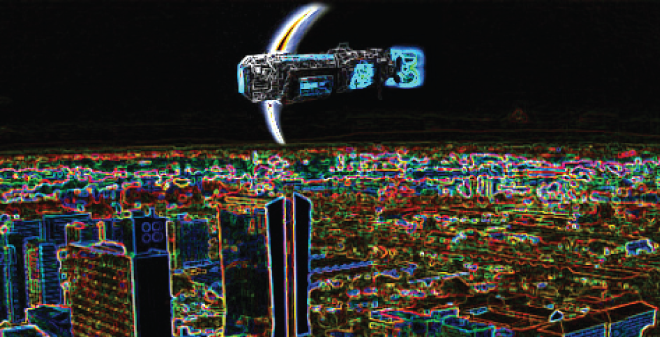
The moon was rising above the skyscrapers of Afropolis, dark and gloomy. It was difficult to make it out in the night sky, only the edges gleamed a shimmering blue—the effect of a million ZEOS solar panels playing tricks with the sunlight. I’d jacked mem-bits from the 21st century that showed the moon the way it used to be when it still reflected sunlight, before the solar farms. It was fucking beautiful.
And this dump of a city now called Afropolis, well, it was still a dump back then, but it had some space; it had real air and lots of natural light. And people, normal citizens, were allowed to walk at ground level. Staring at the cityscape that stretched before me, I wondered if this is what they dreamed of back then. This city of half a billion stragglers, most living in one-person cabins packed in 3000-foot skyscrapers interconnected by horizontal elevators and skyways. I stepped back from the window and flicked the blind switch, watching the chromatic glass slowly blot out the city.
There was half a bottle left of my weekly water ration and I downed it all, thirsty at the though of going out. Night was the best time to visit Quadrant 7 if you were looking for membits from the 21st. Old men, too poor to afford to make money any other way, sold priceless memories for as little as 100 EA$. They sold to me cheaply, because I bought memories nobody else wanted. Love, pain, laughter and happiness, but mostly I bought history. I paid extra for memories of childhood in the late 21st, before the water and energy rations, even before ZEOS itself. I had a modest website where I uploaded them for free, and it was getting quite well known. I wasn’t the only one looking for the feelings we had lost.
The vicious gangs that ran the quadrant did it differently though. They almost exclusively bought sexual memories, and then violence, thrills and intoxication, in that order. And if you owed them for food or a place to sleep (as most of the old men did), they paid you nothing. They preferred to rip them of quality, erasing the memory from its donor’s mind completely. Gaps in the mind drove you crazy after a while, and the quadrant streets were full of people who had sold too much, wandering the streets trying to relearn things they had known all their lives.
The bunk I was sitting on now folded into a panel in the wall, exposing a console underneath with connection ports for a communicator and one more electronic. I turned off the light and grabbed my mem-jack and an old jacket, then left the cabin. It was cold in the corridor; most of the other residents had already gone to sleep. The AC automatically lowered building temperatures to 20 degrees after eleven to save on power. I’d have much preferred an electric jacket, but there were things you didn’t wear in Q7 if you valued your life, like clothes that cost more than 500 EA$.
I entered the lift at the end of the corridor and went down to the 20th floor where the building’s nearest skyway station was located. There was a checkpoint at the exit, and a guard from building security was sitting behind a glass panel next to it, his head lowered in a state of half sleep. I buzzed him lightly and put my pass against the glass. He didn’t bother to look, or wake fully for that matter, simply pressing a button on his counter. The exit slid open in response, and I walked out into the station. A digital counter on the wall showed the time until the next tram arrived.
They were less frequent after midnight, and I’d have to wait almost seven minutes for the next one passing by this station. I walked right up to the glass, staring out at the dense network of rails and building stations that made up the skyway network. Trams were buzzing about, their lights creating mesmerizing trails that ended and started every time they entered, then left, a station. In the vista that stretched out as far as my eye could see, there was not a single person in sight. It seemed like the city belonged to the trams, a city of shiny electric worms that flitted on the skyways from building to building, fulfilling some all consuming, mysterious bidding. A robot city.
Times like these made me want to curl up in my room with a mem-bit, reliving some random old woman’s wedding euphoria or crying some random old man’s tears as he scattered his wife’s ashes over the side of a boat. I glanced back at the building, as monstrous from the outside as it was from the inside, and watched as the last cabin lights went off. Alone in the station, I wondered if they also felt this ancient longing for happiness? If they also saw how low we had all fallen? The electronic station voice snapped me out of my reverie, “Please step away from the terminal.”
I hadn’t been near it in the first place. The sliding doors at the end of the station opened and the incoming tram slowed into place, its door aligning exactly with the opening. “Please enter the tram now.” That’s why I had been waiting in the station. The tram was almost empty with only two other travelers inside; an elderly woman in a body revealing skinsuit and a much more heavily dressed gentleman on the back seat.
I sat somewhere in the middle of the car, closer to the woman. The man’s jacket hood was pulled down over the top part of his face, like a gang runner trying to avoid getting his face identified on the omnipresent closed-circuit cameras. It was really nothing to worry about; they worked the trams all night selling everything from illegal mem-bits to pieces of real fruit and meat smuggled from the Chinese plantations. Even in the high privilege sectors, where peacekeepers rode in every tram to keep them away, they still showed up. Bribing their way using the very same wares they peddled. ‘Psst! Bro!’ called the hooded man, ‘I have all ages of girls, young as you want, only 20 for a mem-bit.” I ignored him.
Growing up a girl in Quadrant 7 was a harrowing experience, especially if you were beautiful enough to attract the attention of the gangs. I’d met girls who begged me to rip their memories so they would forget some experiences forever and sometimes I did. Among Q7 girls, I was known as the only one who dealt in painful memories. The hooded man moved closer, sitting just two rows behind me now. He spoke like before, without lifting his head high enough for his face to be identified. He sweetened the deal. ‘What are you into bro? I’ve got bondage and rape; both men and women. I’ve even got a fat woman.”
Fat women were rare, even in the high privilege sectors. Some filthy rich kid must have recorded that for them in exchange for some of the nastier stuff the gangs specialized in. I turned round to look at him. ‘I’m good bro; I’m not really looking to buy anything right now’ I said. ‘Not even the real stuff? I’ve got that too. Carla!’ The elderly woman got up, unbuttoning her bodysuit as she did. She was in her late fifties perhaps and the breast that spilled out of the suit was withered with age. She walked to the back slowly, turning as she passed my seat.
‘She’s not much to look at’ the man said, ’20 for her.’ I shook my head again. He was desperate now, ‘Okay, how about you have her free if you promise to record it for me.’ I turned round again, speaking more firmly this time, ‘Not tonight bro. Not tonight.’ He lifted his head slightly to get a better look at my face in the dim light. ‘You look familiar, have we met before?’ ‘I doubt it’ I replied. ‘Anything else you want? I’ve got dried bird and lizard, and loads of dried rat.’ ‘No, nothing else’ and then to my relief, he got up and resumed his seat at the back, next to Carla.
I’d be glad when I got off the tram at the next stop. From there it was only one more tram to Q7. ‘Hey’ Carla called softly, speaking for the first time. ‘You’re that guy that buys memories nobody else wants. Aren’t you?’ ‘Yes’ I said after a pause. ‘Go to number 975 and ask for Elsie. Tell her Clara sent you.’ ‘What has she got?’ I asked. Clara leaned back in her seat, switching on the electric heating function on her bodysuit. The eerie glow outlined what must have once been a lovely figure, and then she closed her eyes. She was not going to tell me anything more. ‘I thought you looked familiar bro’ said the hooded man. ‘Be careful going to Mol’s, that’s Qillers territory.’ Outside the window, the trams of the robot city flitted past, their dazzling lights belying the dirty secrets they held within.
In 2150 at the 7th ZEOS summit, the world voted to adopt a universal classification system for cities. Faced with a crippling shortage of resources after world population hit 15 billion, it became important to keep human habitation from spilling over into land set aside for food production. The cities were divided into sectors with different privilege levels with the lowest privilege areas that had previously been called slums now being universally known as Quadrants. Worldwide, the quadrants were assigned numbers corresponding to their respective sizes. The largest, Quadrant 1, was located in Bombay, India with Q7 in Afropolis being second largest in Africa after Q3 in Lagos. A quarter billion people lived here, an area one fifth the size of the city. Neglected by the government, ignored by the city council, and now walled off from the rest of the city by the peacekeepers, Quadrant 7 lived by its own rules.
Bordered on three sides by the skyscrapers of residential sectors, the quadrant only got sunlight in the centre. That’s where the gangs operated from, harvesting and selling solar energy at double the council rates. They also dealt in illegal mem-bits, women, water, and unprocessed food smuggled from the Chinese plantations. A fierce turf war had recently ended between two of the gangs and in a place as thick with humanity as Q7, the toll on human life had been great. In an attempt to turn Q7 residents against the rioting gangs, the city council had cut the power and water quotas by half. I was approaching the first checkpoint after getting off the tram and I noticed the effects of the extreme rationing immediately. Except for the street lamps, most of the lights were off in the houses. It sounded louder than it usually did from this side of the walls and the smell of humanity wafted all the way to the checkpoint at least 500 metres away.
‘What’s your business?’ the peacekeeper asked brusquely. ‘Visiting family’ I lied. ‘You got anything to declare?’ ‘No.’ The mem-jack was in my inside jacket pocket but it was not illegal itself. Ripping memories was illegal though and attempting to declare it would have been foolish. The gangs came in and out with them all the time though and the guards, had they found it, would have simply demanded a bribe. The guard put my ID into a small tray and passed me a stamped guest pass then buzzed me through.
A gate opened on the wall, the entrance leading to a wire tunnel that passed through the no man’s land between the two walls. I glanced to my right where four towers stood facing the slum. Two of them had large parabolic metal discs on them that swiveled slowly left and right over the thronging masses just beyond the wall. Both had RADS printed in bold lettering on their discs, proclaiming their purpose and capability. Raytheon Active Denial Systems; they were pain rays that could easily incapacitate a grown man with millimeter-wave radiation.
When switched to full intensity, they could kill. The rays, known fondly in Q7 as ‘meko’ were there to enforce a by-law from the 7th ZEOS summit that required the containment of Quadrant residents to avoid the spread of crime and disease and they weren’t even the strictest measures there. The no man’s land was patrolled by MAARS land drones equipped with xm-25 grenade launchers effectively making it an automated kill zone and the other two towers held large drums loaded with LRAD cones that could burst eardrums from 500 metres away with high intensity sound waves. The plan was to keep them in there until their numbers dropped, however many years it took.
The segregation was taking its toll on Quadrant residents though. Hardly a month went by without news of a quadrant riot in one city or another, each one worse than the last. Even the smaller quadrants were getting in on the action; 20,000 killed in Kigali’s Q201, 100,000 in Switzerland’s Q190. Governments, wary of the simmering quadrant residents, were carrying out more stringent containment measures. Like this impending slaughter in Q7. The inner gate opened to a smaller checkpoint and the guard there took my guest pass and the last gate to Q7 opened before me. The area in front of the gates was a bustling market; wares spread out on the pavements and hung on vendors’ necks and jackets.
Each vendor shouting in old-tongue, trying to outdo the next one with similar wares. One of the old men had told me the only things that ever changed in the markets of Afropolis were the vendors’ wares; the haggling and noise were from before the old men of his childhood could remember. And so was the crime, you could buy anything from the latest model of ZEOS communicator to a fresh kidney transplant. The poorer residents came to bargain with treasured personal effects including clothes, plumpy nut rations, and water. It was common practice in Q7 to trade in what you did not immediately need for what you needed and reserve what you traded earlier so you could buy it back when you needed it, minus the broker’s commission.
In a way, everything belonged to everyone in the quadrant. I walked past the rows of vendors keeping my eyes away from the wares. They would take even a single glance as an expression of interest and what would begin as an attempt to convince a customer to buy often turned into daylight robbery as the vendors mobbed you looking to grab something to add to their list of wares. I headed west, towards the quarter that held plot numbers 750-1000; Qiller territory.
The building was among the better ones in Q7, a concrete relic of the 21st with twelve floors and about two hundred houses inside. The system was different though; the houses were leased by groups of five to ten people who were the only ones whose places in the house were assured. When night fell, hordes of stragglers wandered the corridors of the houses knocking every door looking for a place to sleep. For between 20sh to 1 EA$, one such house could host up to thirty people each night, sprawled over every inch of the floor in every single room not to mention the ones who upon missing a place entirely, curled up on corridor floors, verandahs, balconies, and in public baths and toilets.
A building like this one gave an average of ten thousand people a resting place each night. The full quarter of Q7 residents who would miss a place to sleep every night could be found lying on gang controlled market squares and the free but more hostile and unprotected street pavements. ‘Nani?’ asked a voice from the other side of the door. I’d forgotten that unlike city cabins, they didn’t have default surveillance out each door. ’Ambia Elsie Felix amekuja kumwona’ I replied in old-tongue. ’Hafanyi kazi leo, unataka mwingine?’ ‘Hapana, mwambie nimetumwa na Carla’ I said. There was a pause, footsteps receded from the door headed inside and then returned. This time the door opened a crack and a girl, not more than twelve looked at me from the space.
‘Are you the one who is buying strange memories, the ones nobody wants to buy?’ she asked in broken English. ‘Yes, do you have something for me?’ ‘My name is Elsie, please come in.’ I stepped into the room, looking around for the first girl. It was arranged like a dormitory, a bed occupying every possible space there was. The other girl was lying across one of the beds, unconcerned. The little girl led me to the closest bed and gestured for me to sit. ‘Do you just buy memories?’ she began. ‘Yes’ I replied, ‘What else is there?’ ‘What are you calling a memory that hasn’t happened yet?’ She seemed dead serious, ‘You mean you have a memory that hasn’t happened yet?’ ‘Yes,’ she replied reaching for a communicator from the pocket of her dress. She removed the attached flash disk from it and handed it to me.
‘Four weeks ago I lived with Carla in 847 not far from here. One day I was sick, I needed much water. Carla wasn’t making big money selling herself because she’s really becoming old now so she borrowed from the Qillers. She said she would pay but she couldn’t. Then I had a memory of Carla riding the trams all night because she had to, or they would come and take me away. She said it wouldn’t happen, but it did. I told her on the train she should look for a man who buys strange memories because I needed to give him this new memory.
She still did not believe me; she said she will never meet such a man because it is not possible to see memories before they happen. I’m happy she believes me now.’ She paused to catch her breath. ‘You must be paying me for it even though I can not tell you what is in it. How much will you give me sir?’ ‘How much does Carla need to stop riding the trams at night?’ I asked. ‘She has 500 left after tonight’ the girl replied. I took out my communicator and transferred 700 EA$, everything I had at the time to hers.
She stood there looking at it and then slowly, a tear rolled down her cheek. She flew into my arms, holding me tight. ‘Thank you sir, you’re the greatest! If you want Elsie I can ask Mary to leave the room…’ I pushed her away gently, ‘No Elsie, all I buy are memories. And thank you for such a special one.’ She was crying now, heavy sobs that wracked her little body, ‘You save Carla from the trams; you’re the greatest person I ever meet. I come and live with you in city, if you want Elsie, you can have!’ I looked at Mary in alarm and finally she thought to help, coming over to hold Elsie as she cried. I left the room hurriedly only stopping when I got to the door. ‘Hey Elsie!’ I said. I waited a few moments for her to stop crying and look up. ‘I just remembered what they are called, these memories that have not happened yet.’ She was alert now, wiping the tears from her face. ‘What are they called sir?’
‘They are called dreams, and they were pretty common in the 21st century. Though back then, not all of them came to pass like yours do.’ ‘Oh, not all mine pass as well, like the one I gave you. Carla said it is too crazy to pass, we can not leave the quadrant anyway. But if you like it please return, I have many crazy memory dreams.’
Two days later, I uploaded the mem-bit on my website after playing it for two nights continuously. In her dream, a hacker, angry at the government and saddened by the persecution of the quadrant residents infects the ZEOS mainframe that controls city council rations with a virus that removes all the quota restrictions on water and electricity to the quadrant, diverting it from the more privileged sectors. For three glorious days, every faucet in Q7 flows at full pressure and every bulb burns bright. The abundance of water leads to new experience for quadrant residents, like the feeling of complete immersion in a bathtub, or water flowing down one’s body.
People do nothing but drink water and splash, adults as well as children. Surveillance cameras convey the three day water party live to the more privileged sectors of Afropolis, and the police, and every other low privilege sector in the five EAC cities. From Q47 in Rwanda to Sudan’s Q32, residents of seven hundred of the worlds one thousand two hundred quadrants respond with riots and protests over the restriction of movement, and the water and power quotas in the quadrants. The quadrant by-law is abolished allowing residents to be relocated to areas with more space, and ZEOS loses is worldwide monopoly on water and power supply. The poor still weep, but the lash stings less than before.
Only two other people knew that the dream as it appeared on the website had been edited; because I carefully removed all the bits that revealed the identity of the hacker. She now lived with Carla in a city cabin not far from where I lived. I had claimed they were family and bribed the peacekeepers to get them new IDs. Elsie would finish her course in computer programming at an academy in the city in another year and then it would be two more years until her sixteen year old self possibly carried out the biggest act of revolution in known history.
“Afropolis:The Child of Prophecy”, by Alexander Ikawah, emerged as the best science fiction story in the 2012 Innis and Outis Science Fiction competition, run by Lesleigh Inc’s Bullet Pen and supported by UP Magazine.

Adam lost his apple because Eve took it. Covetous, she plucked it with delicious abandon from that legendary and alluring tree. She did not waver; Adam had taunted her long enough. And, with one, crisp, robust, annihilating bite, she was exiled. Sent from the Garden of Eden, out of the jungle book, a fugitive forever. Eve ran. She ran at breakneck speed from the land of milk and honey into the unyielding terrain of her future sons, Cain and Abel. From paradise to penitence for one little nibble. I am no Eve.
I’ve never been to Eden, any kind of eden. But I’ve certainly crossed paths with plenty of serpents and not a few Adams. Tempters all, they have kick started my demise from wuthering heights. You yearn, you burn. Hence, I believe in the fruit of the poisonous tree. Most of all, I believe that the apple doesn’t fall far from the tree. So why would a man? I pick the fruit, twirling it in my hand, tasting it with relish and rebellion, paying homage to my favorite apple of all—Adam’s—and the falling from grace that that implies. Ah, the serpent’s kiss. And that very first bite of life. ***** My mother always said, “Earlobes can tell you everything you need to know about a man.” The larger, the more elephantine, the more giving he will be.
They speak to his spirit of generosity, his exuberance for life, his lovingness. When my parents met for the first time in Nairobi—a set up by my paternal Asian grandmother, Anita—my mother confessed: “What attracted me to your father most were his aloneness and his ears.” With lobes, I might add, as dangling as participles. They have been married for 35 years this December. But in my experience of Jesse and Salim and Frank and Liru, the Adam’s apple captures my fancy full throttle, often conveying a greater definition of maleness than does any other feature. Consider the dead giveaway of an Adam’s apple for those—transsexual, transgendered, transvestite—who would transform themselves into someone more ladylike. But there it is, bobbing away. That Adam’s apple speaks to me as loudly as any announcement.
Telling me, by swallow or gulp or flutter, that he is nervous, he is ready, he is mine. I am talking about vital points of entry. And, in my day, even a heyday of sorts, I have worshipped at the neck, that supple conduit between heart and mind, love and loin. The fat and happy, beautiful and hungry, lame and limber—they kiss and nuzzle and lick. The pulse fastens, the throat leaps with each and every caress. Once parked in a car in Westlands near Sankara Hotel, a sweet, chubby, hairless troll of a Luhya named Laurence put his lips just beneath my jaw, under my ear, on my neck, and I thought I would come undone. The sheer upsweep of necking. Ah, but the Adam’s apple, there’s the rub.
Jutting and smooth, like the sweet, perfect pit of a nectarine, suspended for eternity in his selfish throat. I move slowly down the jut of his jaw, along the slick clavicle of candy cane, the honey dip just east-west of it. Roughneck, his whiskers sear my cheek, my chin. An then, the final prize. The peak, the bobsled, the Adam’s apple. The throb and knob of it, the ever-succulent knuckle of the throat, like the Pope’s nose of a roasted chicken. Tasty. Tasting of cinnamon and chocolate and baked apple, it is, for me, the defining point of masculinity—victorious, vital, vulnerable. Yes, that’s it. The perfect speed bump along the neck’s own superhighway of modern romance, my Adam’s apple.

We too mourned when Professor Wangari Mathaai passed away.And, like everybody else in the country, we on the Street made a pledge to take care of the environment, and particularly so by planting trees. However, the same as with many politicians, it turned out to be an empty promise. Empty rhetoric aimed at fitting in with the national mood at the time.
Truth be told, the environment, at least the one outside our houses, is the least of our worries. We tend to treat such spaces, where we live, with the attitude of many a Nairobian—not with a sense of ownership, but with the mindset of a temporary passerby. “The city is not mine. Let those who are responsible take care of it”. The “our” in “Keep our city clean” is left out.
On the Street where we earn our living, we treat cleanliness of our surroundings with casualness. We sit, smoke and drop the filters on the ground, as if we are in some village bar. Then we sip from bottles of liquor and soda before trashing the Street with them. It doesn’t matter that a bin may be only a metre away.
We don’t feel obliged to take the few steps towards it. Later in the night, when we have lost hope of capturing customers, we will channel our frustration into complaining about how dirty the city has become. Wondering aloud why all those who are supposed to keep it clean, have not done their duty. Talking of workers, most streets in the city are swept at night, supposedly when there is less human and vehicle traffic. The workers, always women, will occasionally come to our part of the city, where they curse as they sweep. Though we try to befriend them and hesitate to litter when they are around, it’s all in jest, with no serious commitment to the hygiene of our workplace. The indifference is also ingrained in us when we walk down the Street during the day. Even though many do not litter, it is not because they care about the city, rather because it would be against city bylaws, and the council askaris are usually hovering around to pounce on those who trash.
Yet, there were moments when we kept our workplace clean. I think it’s Nini or some other girl who convinced us that if we kept the Street clean, then the city council askaris and policemen would stop harassing us. After all, if we left the Street better than we found it, then that would be one less sin—perhaps reason enough for the authorities to stay away. So, we made a collective effort to keep our place of work spotless. But it didn’t turn out as Nini had predicted. The city fathers seemed blind to our efforts, and we certainly did not find any redemption with the local police. Eventually we went back to our trashing ways. Another effort was made by a nongovernmental organization that came and sold us the idea of recycling the discarded plastic that was all over our zone. The idea was to make jewellery from the plastic and other trash, then sell it to colleagues and other city residents. Some girls tried; theymade pretty earrings and necklaces, but soon gave up. The fifty-shilling earrings didn’t seem enough motivation, amidst the taunts from the rest of us.
That said, girls who have been on the Street longer seem keener on cleanliness than the relatively new ones. Time makes the girls start respecting the place where they earn a living. Perhaps if we kept the Street clean and stopped thinking it is cheesy to do so, maybe business would boom. Okay. Now, I pledge to keep the Street and city clean in the hope that you clients will come rushing in. Won’t you?


