Heroes with No Names

Laban as an uncanny knack for languages. A true linguist, he’s always surprised us with his ability to converse effortlessly with customers of any ethnic origin in their native tongue. He is an object of both admiration and envy amongst fellow cab drivers.However, Laban is also very compassionate and a firm believer in the dream of a united Kenya.
In 2008, it was a bad time for everybody. Our industry got hit very hard. Transportation was paralysed by various “no go” zones. While the majority of us grounded our taxis and spent time watching our TV screens in shock and horror, Laban took the initiative of assisting victims in securing safe passage out of hot spots.
Using language as a tool of identity and persuasion, Laban was able to save the lives of at least seven different families. The number may not be too large in the grand scheme of things, but to those families, Laban shall always remain a hero. A local television station recently ran a three-part documentary honouring Laban’s efforts, but being the humble person that he is, he declined to have his identity revealed. They had to get a local actor to play the role of Laban.
I’ll also speak about Jamal, my mentor, simply because he gave me a second chance in life. In my earlier years, I had a bright future ahead of me, or so my parents, teachers and friends thought. I was doing quite well in college with top grades and was always actively involved in sports and club activities. This made me very popular with my peers, especially the ladies. Unfortunately, this started to go to my head, and I got involved in several meaningless flings.
To make matters worse, alcohol soon became my best friend. It seemed that I took to philandering and drinking with the very same zeal and gusto that made me excel in academics, sports and social activities. By the final year of college, I had squandered my fees and was holed up in an older lady’s apartment. I had also stopped attending class. I was disqualified as a student for failing to meet the required minimum number of hours to sit for examinations, disowned by my guardian whose fees I had misused, and soon kicked out of the apartment when my “cougar” found a new, younger gentleman to prey upon.
My life started spiralling out of control until a taxi driver by the name of Jamal, who used to ferry me to and from the lady’s apartment, took me under his wing and started showing me the ropes. Were it not for him, I’m not sure where I would have ended up in life. What is more amazing and inspiring to me is that I know at least four other taxi drivers who were in situations similar or much worse than mine; they too received mentorship from Jamal and are now building themselves up as taxi drivers.
Jamal recently died in a botched car jacking. We pray that he may rest in peace. There is currently an initiative amongst a number of Jamal’s protégés to form a foundation that will provide a second chance for those who need to start a career as a cab driver. I believe this is a fitting way to remember Jamal.
Overall, I would like to finally honour those unnamed taxi drivers who, despite being open targets for harassment, theft, exploitation and ridicule, still manage to wake up every day and dedicate themselves to providing service to all Kenyans. We do have a number of unscrupulous operators amongst us, but by and large, the majority take pride in their work and service. It is only fair that I honour them too.
By Milo


A man saves his torturer. Would you do the same?
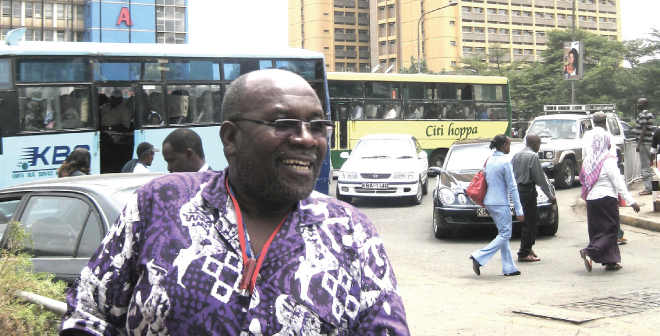
On May 21, 1986, Paddy Onyango was teaching a class at Ogada Secondary School. He was three days away from his wedding day. At 4:00 p.m., he and his class were abruptly surrounded by uniformed police officers with guns pointing directly at them. The officers had come for the former student leader as part of the nationwide abduction, arrest and killing of all those suspected of being government dissidents following the botched 1982 coup.
Paddy ended up at the infamous Nyayo House—a government building designated for the detention and torture of democracy campaigners. The foundation of Nyayo House bore dark water-logged chambers. Each cell was bare faced with only air and water ducts. The first 12 days of Paddy’s ordeal entailed standing naked in a pool of water until he fell down from exhaustion. The next 12 involved starvation.
The torture varied from beatings using planks of wood, to shoving ballpoint pens through his urethra, to having the tip of his genitals singed with a burning cigarette butt. Hot and cold air would be released into his cell at random, and needles were also stuck in his fingernails.
On one occasion, Paddy was stripped naked before guards brought in his fiancée. The guards fondled her infront of him. “That pained me,” he says, lowering his head. His fiancée was then whisked away. Next thing, Paddy heard her screaming from the next room. As a result of being raped by the guards, the woman he loved became pregnant and later committed suicide.
Paddy was released from Nyayo House and moved from one maximum-security prison to the next. He was eventually stationed at Naivasha Maximum Prison for 18 months, locked in solitary confinement with only one hour of sunlight a day. In 1988, a week after release from detention, Paddy bumped into Mr. Munene*, the chief torturer at Nyayo House who drafted “schedules” for each prisoner. That particular day along Aga Khan Walk in Nairobi’s CBD, Munene looked haggard—dry lips, scaly feet, dressed in faded clothes.
Paddy, without hesitating, greeted the former prison guard and offered to buy him lunch. Munene was apprehensive, but eventually agreed to it. He proceeded to open up to Paddy. Munene had grown tired of torture and instead began serving as an emissary for the prisoners. He would provide those in his charge with small pieces of paper to write on so that he could prove to their families that they were still alive.
Munene was eventually caught by his superiors and dismissed without benefits. At the time, he had a young daughter who had graduated high school with several distinctions. She wanted to study medicine, but the government denied her access as retribution for her father’s betrayal.
Paddy, though, had received scholarship opportunities for his family from Amnesty International as part of their rehabilitation program. After hearing Munene’s story, he passed on the scholarship from his family to that of his former torturer’s. The daughter would become a doctor after all.
Still in touch with the Munene family, Paddy is now married with three children of his own. He spends his days as a human rights, gender, disability and constitution consultant with intergovernmental organizations.
“There is no need to get packed in hate. It is good to let go and in that way set yourself free. Social costs and sacrifices need to be made for the struggle,” concludes Paddy.
*Mr. Munene’s full name has been withheld to protect his identity.
By Rose Odengo
Total Garbage
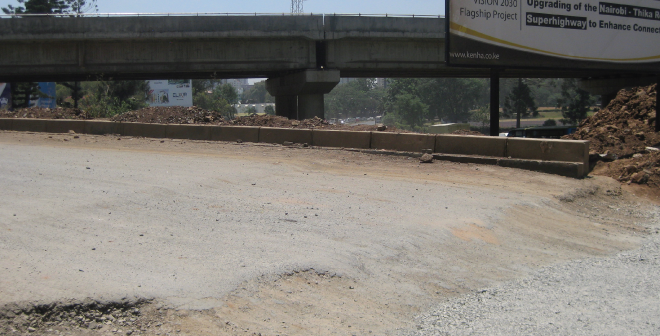
Commuters agree that their transit time into Nairobi has plummeted. But they also lament the lack of signage and lane markings that has landed many a driver unexpectedly in Muthaiga or on River Road, scratching their heads. Lately, however, a new complaint has been heard more and more often: What is the deal with all the mess?
Heaps of old asphalt. Piles of dirt and debris. Puddles of stagnant water. Half-constructed walls which fail to channel away the rain. While a newcomer to Kenya might appreciate the speed of travel that East Africa’s first superhighway affords them, they’re unlikely to appreciate the view. Fingers inevitably point at the Chinese, who contracted the Thika Road reconstruction in its entirety. But can they really be held accountable for the clutter? And does the mess prove they’re not doing a good job?
“You can’t say yet whether the road is a success till it’s done,” says Mugo Kibati, the Director General of Vision 2030 . “Right now it’s a mess. But I marvel at people who expect there to be no messy transition. The work will be complete by commissioning.” This is currently scheduled—depending on whom you ask—for June, July, or August.
“The whole fixation on Chinese versus the West is neither here nor there,” Kibati maintains. “The focus should be on the criteria—and China is meeting them. This is one of the highest-quality roads ever done in Kenya.” According to him, the Chinese contractors are fulfilling all their requirements, and they are doing the work to a high standard—particularly in terms of cost-efficiency.
Given that Kenyan taxpayers are funding the project, largely through loans from China and the African Development Bank, cost-efficiency is a plus. Aesthetics, on the other hand, may be a luxury. Cleanup, landscaping, planting trees—all this is required of the Chinese under the terms of the contract. But according to George Kiiru, one of the Kenya National Highway Authority (KENHA) engineers involved in the design of the superhighway, the contractors technically have up to two years after the completion of the road to clean it up.
“We’re very happy with what the Chinese are doing,” says Kiiru. Of the garbage along the road? “That to me is not garbage. We normally deal with such things in road construction.” Signage, lane markers, guardrails, streetlights—all these are promised before the commissioning, and are, admittedly, more crucial than addressing the mess.
Turn to local contractors, however, and the feedback changes. “According to my standards, they’re not doing a good job,” reports one Kenyan contractor who builds roads in Kenya— or used to, until it became impossible to underbid the Chinese.“They bid too low. Then they don’t have enough finances to do a quality job.” According to this contractor, who asked not to be named, the Chinese have an advantage in that the interest rates in their homeland are so much lower; Kenyan contractors can’t compete anymore.
Offers the Chinese embassy “Despite some media reports indicating some complaints over the duration of the construction and inconveniences caused during the construction, the general feedback is very positive and encouraging.” Only time will tell whether the mess gets cleaned up to everyone’s satisfaction. Plans to maintain the superhighway upon its completion remain undetermined. There is talk at KENHA of public-private partnerships offering incentives to lure companies into undertaking maintenance, but nothing has been finalized. “We wanted a highway able to carry a lot more traffic,” says Mugo Kibati. “But we also want to change the driving culture.” The results of that plan may not be visible for awhile longer.
administrator
LATEST EVENTS
AROUND THE WEB


