The Forgotten” Middle Class

German photographers, Miguel Hahn and Jan-Christoph Hartung capture societal issues with more than just depth of field. Their recent photo essay, “The Forgotten”, offers an alternative view of Nairobi’s middle class whose narratives are remarkably absent from the mainstream media. An article in a German newspaper spurred the duo’s month-long trip to our capital city.
“Our research confirmed that Nairobi has one of the fastest, growing middle-classes in Africa,” says Hahn. Once here, they employed a combination of planning and serendipitous encounters to find their subjects. Hartung says, “We were sitting in a restaurant one day, and started talking to a professor about what we were doing in Kenya. He invited us to his house and showed us around, such things happened to us a lot.” Hahn and Hartung made full use of their Facebook page, in which the public followed their progress.
The end result is a gallery of men, women and children at their places of work, at home, at recreational spots, even at a wedding. This interpretation of Nairobi’s middle class in their “natural habitat” raised debate over the choice of subjects—which included UP’s associate editor and UP’s office caretaker. “We decided that anyone who defines themselves as middle-class would be suitable for our project. This generated a lot of criticism from people who told us that our subjects, were either too rich or too poor,” Hahn adds. Next year the “The Forgotten” will be exhibited at the Festival-Circulations in Paris, which features work by young Europeans.
“We would also love to have an exhibition in Nairobi, because we had the impression that the subjects really appreciated what we were doing,” Hartung concludes. Other works by Hahn and Hartung include “Almost Europe”, a photo-essay that uncovers the lives of illegal migrants from sub-Saharan Africa and Asia who use Melilla, a Spanish city in the north of Africa, as a transit point to Europe. “Afghanisland” looks at soldiers training in re-modeled, Afghan cities, all within the Bundeswehr military training area, in Germany. Check out more images of “The Forgotten” at www.hahn-hartung.com/the_forgotten.html
By Josephine Opar


Zia Manji’s Beautiful World of Black and White
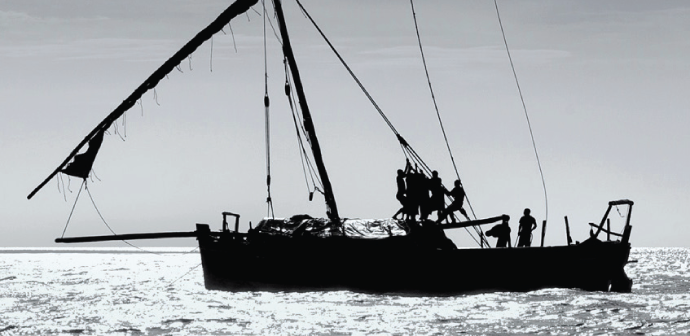
Zia Manji has set himself apart in the field of photography. His portfolio boasts breathtaking black-and-white waterscapes, inspired by the belief that “water is a means through which a sense of personal balance can be achieved.”
Back in his primary days, Zia’s school associated art with paintings, something he wasn’t too good at. “My motivation was drawn from wanting to be the first kid to have a black-and-white image on the school magazine’s cover.” And once he achieved that, there was no turning back.
Zia started off as an analog photographer and, after a decade, he had found his niche. However, the turn of this century heralded the slow death of traditional dark rooms for developing pictures. By 2009, Zia had moved into digital sphere, yet still remained true to his analog roots. “I process all my images on a computer, but limit any skill that could be imitated in the dark room,” he says, setting himself apart from “Photoshopping”, often applied in modern photography.
Zia’s care and precision is particularly evident in some of his images that speak of the oft-unnoticed power of reflections on water—a lone dhow in Zanzibar anchored in the middle of the ocean, the mirroring of the world-famous St. Mark’s Square in the canals of Venice, or cascading waterfalls in Kenya’s own Karura Forest.
All of these black-and-white photos exude movement, a specific impression of water and sky. Zia achieves this effect by mounting his digital camera on a tripod. He then uses long exposures of up to 10 minutes to capture minute details not seen by the naked eye. “Equilibrium: A Moment in Solitude”, Zia’s debut exhibition held this past June at the Michael Joseph Centre, displayed his solitary pursuit of subjects cohabiting with water. (The artist plans to donate approximately KES 1 million from sales of “Equilibrium” images to charity.)
A globetrotter of note, Zia continues to travel around the world to photograph more waterscapes, enthralled by their aesthetic qualities. Over time, he has developed a personal relationship with his motifs. “Sometimes I have to sit and stare at a waterscape for a whole afternoon,” Zia admits, “and [then] return to photograph [in] the morning, or otherwise [I] end up feeling like I’ve invaded its privacy.”
For more information on Zia Manji, visit www.ziamanji.com.
By Anyiko Owoko
LATEST EVENTS
AROUND THE WEB


