Sasa Nairobi
Hosted by Goethe-Institut, contemporary artist Michael Soi presents a series of 17 paintings celebrating women from all over Nairobi, bringing you different takes on the...
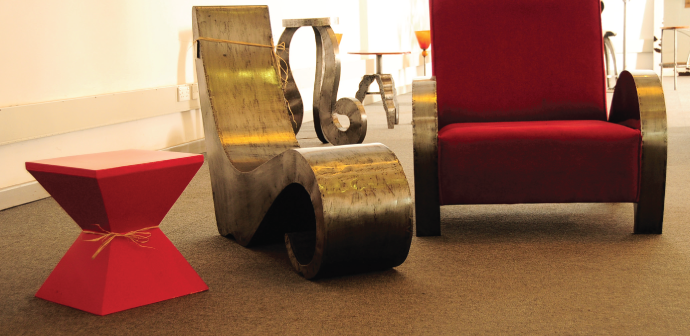
Kenyan furniture is as diverse as the peoples of this land. Aside from the famous Swahili discipline of furniture design, most furniture makers in Kenya tend to be molded by the market. As such, they either produce verbatim copies of European catalogue designs, or they follow the trends dictated by the tourist market.
Three designers in Kenya, originating from as diverse countries as Belgium, Australia and Italy, have managed to combine the best of both worlds. They are raising the bar in furniture design in Kenya, while keeping an eye on the carbon footprint of their production. One is the legendary Marc Van Rampelberg. Originally from Belgium, he came to East Africa as a volunteer teacher in the ‘70s. In the early ‘80s, he married the Kenyan sculptor Chelenge Chelangat, and settled down to have a family.
Marc made furniture for his own home, and eventually received several orders. With time, he opened a workshop and hired and trained local fundis. These craftsmen execute his superb designs with their trademark organic curve, using not a single bolt, screw or nail. Because his designs are soft and fluid, their sense of visual movement creates a deceptively light silhouette when, in reality, they are sturdy, heavy pieces. Marc uses the durable and flexible Mvule wood, Palm wood, Cedar, Ebony and Mahogany.
His work has graced venues such as the Sankara Hotel, Mercury Lounge, the homes of Meryl Streep, British actor John Hurt, and a hotel suite for former President Jimmy Carter. Rampel Designs only uses wood from suppliers where reforestation is a priority. Australian-born Michael J. Calnan of Funzi Furniture is another notable designer of Kenyan furniture. He arrived in the ‘70s from Australia. After an overland journey through the Sahara, Mike decided to settle in Tiwi, just South of Mombasa.
Within a month, Mike’s house had functional furniture, and soon friends wanted similar pieces. Today, his company exports pieces all over the world. Like Rampelburg, he enables his craftsmen to work at their own pace and is rewarded with outstanding results. Some of these pieces take up to two years to make, using no electricity or power tools—only natural, traditional methods and tools. Mike states, “I recognized in the local traditional craftsmen a wealth of talent lying mainly dormant. It made me realize that with a little guidance, much can be created out of really very little.
They certainly had access to some of the finest woods I have ever seen, and they have an amazing eye for form.” Mike and his partner Sabine have started a charity program called Carbon Credits to plant 25 acres they purchased nearby with several thousand indigenous Bamba Koffi trees. Jutta Gavidia Wilhelm, an Italian designer who shuttles between Kenya and Tuscany, is a seasoned artist who uses the medium of soft iron to express her creativity. Her brand is Pinkopallino Designs with its flagship store at the Village Market Mall. “Having lived in several continents amongst different cultures makes my designs unique, since they are a reflection of the impressions stored and assimilated in my soul,” she explains.
“Creating items for interiors and functional items of beauty is a form of design choreography, a spiritual process to alter my surroundings positively. I believe each country I have visited has a unique flavour, and this should be expressed by use of local, renewable and sustainable materials. For that reason, I prefer not to use wood. Through my chosen medium of soft iron, I am able to express my creativity best through a unique process that is easier on the environment.” Jutta works with self-employed local artisans who operate from their various workshops. Some have been working with her for over 19 years. Her designs can be found at the Tribe Hotel, Panafric Hotel, luxury tented camps and private homes. Funzi Furniture
| < Prev |
|---|


