
The Blessings of Beer
...
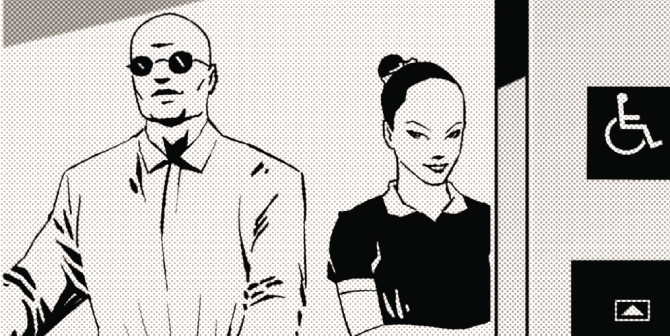
It was an odd gathering—a judge, resplendent in a dark robe and horsehair wig, and two men in wheelchairs. There, amid blaring car horns and curious onlookers, the party conducted judicial proceedings in the open-air car park. This was because the court of law, much like dozens across the country, was not accessible to persons with disabilities (PWDs). Fixed seats, narrow corridors, sidewalks and out-of service elevators (where they even exist), prevent PWDs from accessing public services to which they are entitled.
It is a familiar scene found at nearly every building in Nairobi. And according to the 2008 Kenya National Survey for Persons with Disabilities (KNSPD) Preliminary Report, this is what nearly two million people in Kenya experience every day. People like Francis Mutegi, a mid-30s broadcast journalist with a golden voice. The newlywed father of one has been using assistive devices from an early age and is now on crutches.
He says, “If the steps of a building are not on the same level as the entry point, it can be really difficult to manoeuvre your way in. And even when you do get in, some of the buildings were not constructed with those who walk on fours (using wheelchairs and crutches) in mind.” Mutegi speaks of staircase steps that are too close together. This, he explains, denies a person on crutches the chance to pause and gather energy before taking the next step. “Even in times of an emergency, a disabled person has to slowly make their way down the stairs,” he shares.
And the government itself has been moving at an excruciating slow pace when it comes to passing the relevant legislature to solve accessibility. Emblematic of this is the group of protesters with disabilities who camped outside State House in 1964. They were seeking audience with the then-Prime Minister, Mzee Jomo Kenyatta. Thirty-nine years later, the 2003 Persons with Disabilities Act was enacted.
The act established the National Council for Persons with Disabilities (NCPWD) to help achieve equal opportunities for persons with disabilities in every aspect of public and private life. Of note is Section 22 that stipulates in part (1) “a proprietor of a public building shall adapt it to suit persons with disabilities in such manner as may be specified by the Council.” (2) “All proprietors of public buildings shall comply with subsection (1) within five years after this section comes into operation.” 2012 makes it nine years since the act was passed (and four since the directives in Section 22 lapsed).
When UP conducted an informal survey of popular public buildings, we found a piecemeal approach was being applied. Select number of buildings at City Hall had ramps; the ramp at the Supreme Court of Kenya was located a long distance from the main entrance; and the University of Nairobi had working lifts, though some were in deplorable states. Meanwhile, the Central Police Station had neither a ramp nor handrail in sight. But whose responsibility is it to crack the whip, anyway?
Essentially it is the responsibility of NCPWD. It is up to this government body to inspect public buildings and make sure they comply with the standards. But their reach is fairly limited. “[There’s a] lack of an enforcement framework to make sure the provisions within the Disability Act 2003, the Constitutions and indicators in the [Performance Contracts of all Ministries, State Corporations, Local Authorities and tertiary institutions] are implemented and enforced,” posits Mr. Isaac Manyonge, Disability Mainstreaming Advisor, NCPWD.
“Mainstreaming” ensures that disability issues are made an integral part in the policy formulation, design, planning, implementation, monitoring and evaluation of both public and private organization programs. Thus it falls on this department to carry out accessibility audits to find out whether public institutions have accessible service points to PWDs. The lack of action on the part of the body comes down to cost (read: the government doesn't make PWDs a budgetary priority).
Though Mr. Manyonge argues that “It’s very expensive to install elevators that have audio, visual and tactile components. Most institutions take Disability Mainstreaming as a ‘by the way’ component, only to awaken when one of their own graduates to disability.” Lucas Keya, Kenya Paraplegic Organization (KPO) Program Officer echoes these sentiments. He says, “It is expensive to effect these changes. Reconstruction has to accommodate the unique needs of the disabled and account for architectural shortcomings. [It also] interferes with the original design of buildings.
“Imagine if you take an old building and attempt to install an elevator? It would be severely compromised. Sometimes it is not possible,” adds Keya. But there are those who have taken up the challenge. Keya points to an attitude shift within the private sector. He singles out partnerships with Safaricom and Sameer Group that have led these companies to make their work environments handicap-friendly zones by simple acts such as installing ramps at the buildings’ access points.
What of the attitudes of the general populace? Are they handicap-friendly? “[Disabled] people who mostly use matatus often suffer a lot. Getting to a bus station is an issue in the first place. But then you find that the conductors don’t want to admit you because they see you as a bother. The seating arrangements are also not favorable, especially if a person does not have leg joints,” says Mutegi. That’s why, after much sweat and toil, Mutegi managed to purchase a vehicle because “life becomes almost unbearable without it.”
But Mutegi is now part of another statistic. In a city of nearly two million PWDs, there are only 22 parking spaces in the CBD and 70 at major shopping malls across the city demarcated for the disabled. This begs the question: Why is Nairobi handicap unfriendly? “For the time I have been in ‘Mainstreaming’, willingness has not been an issue. However, prioritization has been the problem,” ventures Manyonge.
Commendably, the department has achieved some measure of success. They’ve developed Disability Mainstreaming Policies together with the Ministry of Roads that cater for that ministry, as well as for Kenya Rural Roads Authority, Kenya Urban Roads Authority and Kenya National Highways Authority. “The Thika Super Highway is an example of flyovers that have both ramps and stairs,” he says. But more needs to be done across the board. One can only hope that the KES 268.1 billion, set aside for infrastructure development in the 2012/2013 KES 1.45 trillion budget, will finally affect some of the changes needed. And perhaps allow all PWDs to have their day in court.
| < Prev | Next > |
|---|


