Without Fear or Prejudice
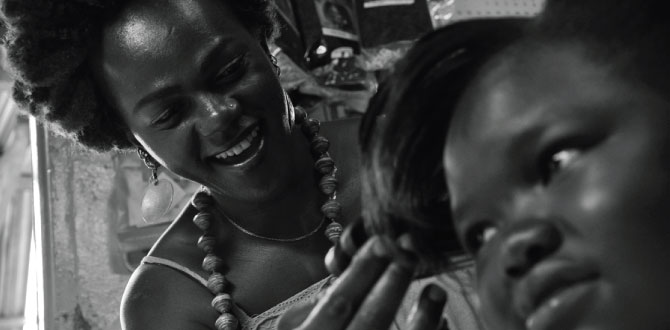
At first sight, 25-year-old photographer Tobin Jones comes across as a natural born artist. So some of his first words come as a bit of a surprise. “I was never one of those kids who fell in love with photography at age 10,” says the shutterbug casually wearing a checkered shirt and a small woolen hat that doesn’t completely cover his long hair. After finishing high school, Tobin, of American-English descent, went on an escapade to Fiji with his tiny point-andshoot camera.
That’s when he discovered his love for photography. “The rest is kind of history,” says Tobin who, once in university, bought himself a classic Pentax K2000. His most recent projects documented the life of Maurine, a transgender from Nairobi. The photo series displayed an unusually normal life for a transgender living in this part of the world. The poignant images won second prize in the 2012 Pride Photo Award, Documentary Category. Held in Amsterdam, the Award is an annual international photo contest for photos depicting sexual and gender diversity, held in Amsterdam. “I was glad she let me into her world. We can’t dismiss the fact that [people like Maurine] do exist but the question is, how many can express themselves freely?” poses Tobin.
This is typical of Tobin whose work incorporates African success stories. He explains, “Unlike the numerous images of the wars and natural disasters of Africa in the Western world, there are positive changes taking place on this continent…” Tobin refers to his style of photography as “classical” and then credits it to growing up reading magazines such as National Geographic. He says, “As I get older, my style is getting a little more edgy. I am now starting to put a little more emphasis on things like the atmosphere and mood of photographs rather than just the aesthetics making me sometimes oblivious to my photographs that are out of focus or strangely framed.”
The globetrotter is currently working in Somalia as a photographer for Albany Associates, an organization championing communication in conflict zones. “It’s a risky place to work but I am content to be part of documenting the history that’s being made by Somalia, a country that’s finally changing for the better,” concludes Tobin.
Anyiko Owoko


Sunset Bullies

It all happened so fast. I was trapped before I could think straight. I was going to the bus station after my evening class in campus at around 9:00 p.m. when a guy in an overcoat popped up from the passenger seat of a saloon car with tinted windows. “Kijana (Boy)”, he called. I stopped in my tracks. “Where’s your ID?” he asked. He pulled a badge from an inner pocket and brandished it as he waited for me to display my own identity. He wasn’t in police uniform, but he could be a karau from the plainclothes division, so that is what we will call him.
It didn’t occur to me to check the car’s number plate for the letters “GK”: Government of Kenya. Before I knew it, the Karau’s friend from the backseat had circumvented me. He sneaked behind me like a shadow, so let’s call him Giza. Karau ordered me to enter the car; they would take me to the police station. I protested that I had the document they requested, but Giza shepherded me into the vehicle. I thought I was being subjected to the bribe-seeking police harassment I’d often heard about. I could imagine the charge: loitering with intent. I had a mind to argue but I didn’t want “resisting arrest” added to my offences. I was sandwiched at the back between Giza and a guy whose face was shadowed to the nose by the brim of his kofia (khaki sun hat). His hands rested on his lap, as if cuffed. I assumed he was a crook who’d also been nabbed. As the driver took off, Karau asked if I had an ATM card.That’s when the gravity of the situation hit me.
I said I was just a student. What was I doing in town at night? I’d come from campus. Which one? University of Nairobi. Kofia broke his silence. “You youths are the ones who make trouble,” he said in heavily accented Swahili, lumping me together with the students who stone cars whenever there’s a strike. “Today you will know us. We are Mu-ngi-ki!” Beads of cold sweat sprouted on my forehead. My underarms grew damp. I was remembering reports of beheaded bodies being found in farms. They belonged to the victims of this extortion mafia. By now, we’d turned into the highway. There were people under the streetlights waiting to cross the road to the railway station.
The traffic lights turned red before we could pass. In a moment of bravado, I leaped to the left window screen and started banging it and screaming. I’d hardly knocked the screen once when Giza grabbed me in a stranglehold and bent me forward until my head was between my knees. Kofia pulled my arm back and twisted it behind me. “Urgh!” I groaned as a pang of pain shot up to my shoulder. “Who are you making noise for?” Kofia asked. He used his free hand to cover my mouth, getting a yelp-inducing bite from me. Karau placed what felt like a barrelled object at the back of my head. Self-preservation made me freeze. The traffic lights must have changed just then because the car got back into motion. My heart sank. As the city’s lights faded behind us, Kofia pounded my head and back with a blunt, metallic object for my troubles, calling me a dog for biting him. I raised a hand to shield my head and my index finger got smashed.
I apologized profusely but my pleas fell on deaf ears. Meantime, Giza locked my torso between his legs and began to empty my pockets of a mobile phone and wallet. Several rounds of frisking ensued while Karau interrogated me about my family, as if planning to demand ransom. After about an hour, I sensed the car drawing to a halt. Giza opened his door and a grassless field greeted my eyes, hazy in the crescent moonlight. “Get out and don’t look back,” Karau said. With blood matted in my hair and smeared across my fingers, I climbed out and staggered away, holding up my unbelted trouser to keep it from falling. After about fifty metres, I dared to glance back and saw the taillights of the car retreating into darkness. Fighting back tears, I began my long walk of shame to get help. I doubted I’d get any justice. I’d just become another statistic of the crime that lurks at night around the city in the sun.
Tom Jalio
Culture Power

How can the arts and culture act as a powerful factor in our society and help drive positive change? Good question. To be slightly pedantic, perhaps the words “power” and “culture” ought not to be mentioned in the same breath. “Power” suggests a constant, quantifiable force that can be summoned instantly, on command; whereas culture is an equally mighty force, but one which, by its nature, is gradual, perceptible and mostly immeasurable. However, as one who is a great believer in the power of the arts and culture let me attempt to answer by way of anecdotal example. You may have watched the opening ceremony of the recently concluded Olympic games.
The host country seized it as an opportunity to showcase “Brand Great Britain”. People like actor Sir Kenneth Branagh, brought out to recite some lines from Shakespeare; author JK Rowling, creator of Harry Potter, to read from a children’s story; Rowan Atkinson, “Mr. Bean” himself, to play a single note on the piano as his inspired contribution to an orchestral piece. And of course, some of the definite highlights were a re-edit of the promo for the film “Chariots of Fire” and Sir Paul McCartney singing “Let it Be” for the grand finale.
Also highlighted were success stories, such as the industrial revolution (without drawing attention to the pillaging of Africa’s resources to bring it about) and the National Health Service (a segment deleted in the US coverage, lest it encourage “Obamacare”). There was also quintessential British pop music and memorable British TV series. A choreographed dance sequence (also deleted in some parts of the world) lauded Britain’s racial minorities. And, of course, the queen put in an appearance (albeit in waxwork personification at first) parachuted safely into the stadium with James Bond (personified by actor Daniel Craig) as her personal bodyguard.
My other anecdote has to do with the time when I presented The Zain Africa Challenge. It was an eightnation, inter-university, general knowledge quiz show. During the banter between rounds in a particular contest, I asked a student from Malawi about what he enjoyed doing outside the classroom. “Reading poetry,” he replied. Could he recite from a Malawian poet? Yes, he could. And he immediately launched into “Songs of Chickens,” by Jack Mapanje, long detained at some point by President Hastings Kamuzu Banda.
“Master,” he intoned, “… you talked with bows, /Arrows and catapults once/Your hands steaming with hawk blood/To protect your chicken. / Why do you talk with knives now, / Your hand teeming with eggshells/ And hot blood from your own chicken?/Is it to impress your visitors?” I think that you have caught my drift. Substitute “Kenya” in both instances. Would we be capable of holding such an Olympian spectacular? Would a young Kenyan stand up to recite the words of a nationally acknowledged, poet laureate? Sadly, the answer on both counts would have to be “no.” And that negative answer in itself points to the role that the creative arts and culture can play as a powerful factor in our society and help to drive positive change. I do believe that a conscious investment in culture and the arts, at best with our educational system as a foundation, would forge links of common humanity, heal wounds of ignorance and prejudice and make us a nation not only on paper but in our hearts and minds. Now, that’s powerful.
By John Sibi-Okumu
Is Nairobi Virtuous Enough?
From our homes to our work places, our schools and our communities, architecture affects us all. It is the arena in which the rituals of our everyday life are played out. Architecture designs our lives through the spaces we live in. It has the ability to improve and change our lifestyle, make us happy and productive. Equally, bad architecture can be oppressive and make us miserable. Good architecture has historically been judged by the ancient Vitruvian measure of Firmness, Commodity and Delight; this still rings true.
Only when a building is firmly constructed, serves the functions of its users and is pleasing to the eye, is it considered to be good architecture. Architecture reflects the society that builds it, but also affects the way that society develops. It is a permanent statement about the condition of our society. Reading the city is like reading the history and politics of a place in the layers of built form over time.
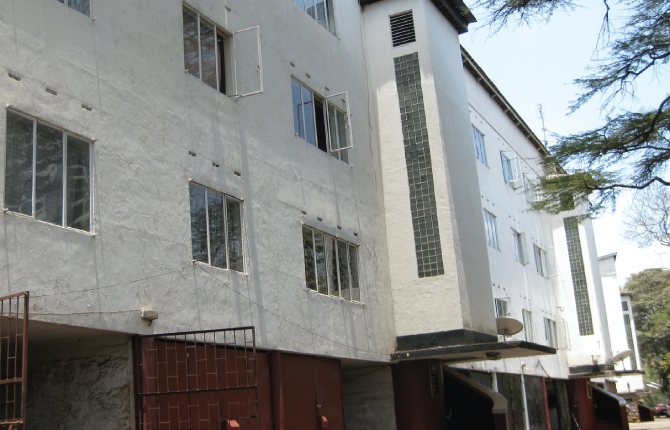
One example is the Delamere Flats designed by Ernst May in 1939 and completed in 1951. This is a building type that is deeply connected to human experience and reveals much about the state of Kenyan society. The project represents a rejection of colonial influences, and marks a particular identity that weaves local building practice of the time with climatic and modernist influences.
May’s use of logic, optimism and idealism aimed to improve living conditions, and establish a model for a good standard of affordable housing in a rapidly-changing society. These are issues that are still as relevant today as they were when the apartments were built over 60 years ago. There is plenty more interesting architecture to discover in Nairobi. A wander through the city centre will introduce many of the capital’s well known and loved buildings.
There are the obvious monuments such as KICC, City Market, Holy Family Basilica, and many of the government and university buildings. There are also surprising courtyards and atriums to be discovered through passages within some of the non-descript office buildings. But these architectural gems are mostly produced in the early post-independent period, and, sadly, thereare few contemporary standouts.
As a discipline, architecture should pioneer new ways of living, explore new materials and technologies whilst rooting itself in its context and time, ensuring that what we build is economically, environmentally sustainable, and appropriate for its users. Most importantly, architecture should be about the production of beautiful buildings and spaces that help our cities and communities function well and make us happy. In as much as there are so many plans afoot (from Tatu City to Globe Waterfront) that purport to carry us into the future. Do these designs live up to the basic Virtruvian measurements? Does it serve us? Let us build the future with this in mind.
Bethan Rayner has a Masters Degree in Architecture at the University of Edinburgh. She has worked in architecture practices in the U.K., U.S.A. and Mexico, and has had an apprentice-style education as a furniture maker in Scotland. She is the co-founder of Studio Propolis, a Nairobi-based full service design workshop focused on crafting beautiful, imaginative, quality spaces and furniture.
By Bethan Rayner
Kenyan Web Designers, Wake Up!

I will not mince words. The truth is that most of the Kenyan (even African) web designers, who designed (or rather attempted to design) the sites I often visit, have become a disgrace to the profession. They have smeared the art and jumbled up the beautiful poetry that was once called web design. If you doubt my seemingly harsh words, please take a look at our State House website and compare it to the awesome White House website. Let’s face it. Kenyan web design sucks, plain and simple.
The few good sites that I have seen are largely unaltered premium themes. No one seems to be “creating” anything. How then can it remain a creative field? But, to begin with, has it ever been a creative field? The undesirable effects of this trend are more than you can imagine. It’s a total mess. I’ll try and give you a sketchy picture of our current web design reality, the result of quacks working for big time clients, while a few professionals work for clients who have absolutely no inkling of what it takes to design a good website.

Firstly, when clients have asked for a rough estimate of what it will cost to design the websites they want, my response leaves them looking at me as though I were a Martian. No kidding. The most common tactic they pull out at this juncture is the complaint, “But… You know… There’s this web designer who told me he can do it for only KES 40,000!” Sometimes I am forced to reply, “Then why are we here, talking about your site?” Kenyans should note that in places like the U.S., designers are paid per hour! We have a long way to go before that level of professionalism and trust is established.
We have to re-educate the “designers” who quote peanuts, download a free template, change the logo and photos in a day or two, then sit around for three weeks to give the impression that they are working hard before they go to collect the cheque. If someone in Kenya were to ask you what you do, and you said that you are a web designer or developer, they’ll give you as much respect as a form-four leaver who took a course in Microsoft Word. Almost everyone who approaches a designer starts by saying “I just want a simple website.” That is usually what precedes a long list of programming and thematic back-flips you have to do to achieve the desired result. Yet it’s still considered “simple”! Then it seems that it has gotten to a point where even the visitors do not expect much from Kenyan websites. Daima mimi ni mKenya (I’m a patriotic Kenyan), but I particularly loathe the designs of government websites.
Of course, I can openly critique them because they are mali yetu (our property), but also because of the lack of concern for quality and professionalism in web design and development. These kinds of sites that litter cyberspace give visitors absolutely no desire to stay or return. Indeed, it’s a disgrace to the profession. I have to mention that although the majority of designers are a product of their own desires, there are some honest aspiring ones who have been shortchanged. I was one of them. I attended a well-known IT college to study web design. It cost me an arm and a leg. However, what I learnt there was basic training.
They taught us how to insert tables and images in Dreamweaver, and how to drag links into the document. Period. By the time we finished the course, no one had even been taught how to upload their shoddy site. Had it not been for my constant search in blogs such as Vandelay Design and Smashing Magazine, I would have been as crappy a designer as the ones I described above.Overall, whether it’s strictly programming or designing, the element of creatively solving problems is indispensable. Along with passion and an unquenchable curiosity and desire to keep growing. So wake up.
Huston Malande is the co-founder and CEO of Skyline Design Ltd (www.skylinedesign.co.ke). It is a web development and branding company that does bespoke design for glbal, high-profile clients.
By Huston Malande
LATEST EVENTS
AROUND THE WEB


