Sasa Nairobi
Hosted by Goethe-Institut, contemporary artist Michael Soi presents a series of 17 paintings celebrating women from all over Nairobi, bringing you different takes on the...
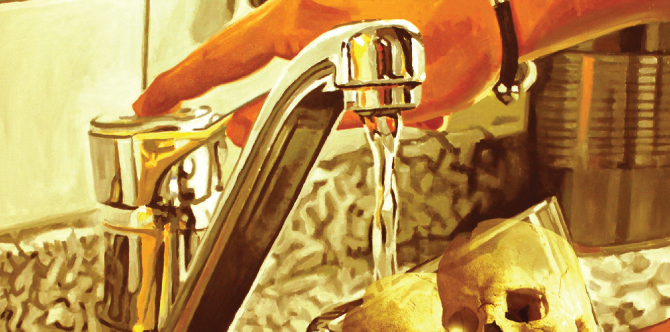
Residents of Karen Ngong View Estate are under assault. The seasonal stream in the area that feeds the Mbagathi River has turned into a perennial flow with hundreds of thousands of gallons of raw human effluence. “The stench and visible pollution on our property became so serious that we couldn’t ignore it,” says Lizzie Gilbert, a resident and member of the Karen Ngong View Estate Association, which has started work towards fixing this crisis.
“I worry about the water table, the danger of the pollution on our property, and [for] all those who live and work there.” This pollution, the estate committee asserts, is deliberate. The primary culprits, identified in a call-to arms addressed to the residents of Karen Ngong View, are three schools located above the estate—Maasai Girls and Teachers College, Hekima School and Elirama School—as well as individuals and businesses building on the riverbank. They are accused of piping their sewage wastedirectly into the stream.
Tests done on water collected further downstream bears out this accusation, or at least the accusation that sewage waste is finding its way into the stream. “The water sample had coliform bacteria,” says Dr. Ruth Chunge, a medical parasitologist and the co-director of the Centre for Tropical and Travel Medicine (CTTM). “These bacterial forms are commonly found in animal faeces, but the sample had Escherichia coli (E. coli), which is evidence of human faecal matter.”
Besides E. coli, dangerous levels of protozoa, intestinal parasites and other bacteria were found in the water, which could be responsible for typhoid, cholera, dysentery and a host of other diseases in humans. Officials of Hekima School and Maasai Girls were unreachable for comment, but Mr. Saldera, the principal of Elirama School, was outraged by this accusation. “The investigation wasn’t done very well,” he said. “The vandalized pipe they say is responsible for pollution is not ours. It passes through the school but it belongs to the Ministry of Water.” “We use pit latrines,” added George Kimani, a director of the school, “so that waste cannot be ours.”
Nobody in the direct employ of the Ministry of Water and Irrigation seemed to be aware of this vandalized pipe in the Karen Ngong View area. Instead I was referred to the Athi Waters Services Board (AWSB), a state corporation under the ministry that is directly responsible for the infrastructure that supplies water in Nairobi, and takes away the sewage from our homes. Very apropos, since Mbagathi River is a tributary of Athi River, but they, too, had no knowledge of the broken pipe.
“The drainage systems are old so we rely mostly on physical inspections,” said Joseph Kamau, an engineer with AWSB. “But we are installing more and more detection systems.” But detection isn’t the only problem with old drainage systems. “The City Council of Nairobi has done a good job of cleaning water at the source,” says Dr. Chunge, “but our distribution systems, the pipes, etc., are very old and have so many leaks that the water could very well be contaminated by the time it comes out of the kitchen tap.” It doesn’t help that the sewage system runs parallel to the water distribution system, making contamination that much easier.
Most of the water in Nairobi is, however, contaminated directly (as alleged by the Karen Ngong View Estate Association in their area). The Nairobi sewage system, according to reports by the AWSB, covers about 40 percent of the city, with a smaller percentage of the population actually connected to it. Informal settlements contribute much of the garbage and human waste that pollutes our rivers, due to lack of infrastructure to cater to this need. “This water is fed back to slum residents by private water providers illegally tapping into our systems,” says Mr. Kamau, “but we are working to fix theunderlying problem.” He speaks of the Nairobi Sewerage Improvement Project, a four-year initiative that is part of the Nairobi River Basin Programme, piloted by the government in conjunction with UNEP, UN-Habitat and other stakeholders.
The project seeks to overhaul the sewer system in Nairobi, starting with areas that really need it: “Dagoretti, Kawangware, Kangemi and Githurai, among others.” The project, unfortunately, is still in the evaluation phase and will, more likely than not, take longer than four years to complete—if it even actually gets off the ground. One lives in hope.
| < Prev | Next > |
|---|


