Sasa Nairobi
Hosted by Goethe-Institut, contemporary artist Michael Soi presents a series of 17 paintings celebrating women from all over Nairobi, bringing you different takes on the...
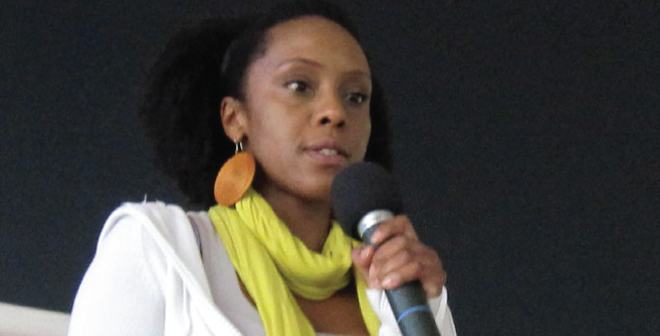
For a long time, the tech scene in Kenya was considered to be a domain for men. However, one lady continues to defy the odds at the Information Communication and Technology (ICT) Board of Kenya. Ms. Kaburo Kobia, For a long time, the tech scene in Kenya was considered to be a domain for men. However, one lady continues to defy the odds at the Information Communication and Technology (ICT) Board of Kenya. Ms. Kaburo Kobia, who is Project Manager for Local Digital Content has been very instrumental in ensuring the growth of innovative technology in business.
“I was always fascinated about computers, but my original love was for art and design. I studied Fine Arts at university and was fortunate to be exposed to computer-generated art. In the late 1990s, I started designing websites and that led to a career in digital media and communications,” says the caramel-skinned techie. One of the constant issues Ms. Kaburo bemoans is the underrepresentation of women in the Kenyan tech industry.
She explains, “In our programs at the Kenya ICT board, we find that only about 15% of our participants are women. If, as a country, we are to reach the goals outlined in vision 2030, then we must get more women to work in the ICT industry.” According to her, the interventions for addressing the low numbers of women choosing a career in ICT must come from all angles. Ms. Kaburo applauds the work already being done at the University of Nairobi’s FabLab Outreach Program.
“The program uses colorful blocks and tools from Picoblock and GogoBoard Kits to teach kids the basics of science, engineering and robotics. Programs like this and other home-grown initiatives must get the support they need to reach schools across the country,” she says.
The second option would be to raise the profile of women. “The Kenyan women in tech are awesome. We’ve got software developers and entrepreneurs, engineers and inventors, bloggers and designers,” Ms. Kaburo states firmly. “You’ll find women across the ICT spectrum working hard and achieving great things. Their role and their voices need to be amplified.”
For more information on the Kenya ICT Board visit, www.ict.go.ke.



As mobile application competitions Pivot 25, Garage48, AppCircus and IPO 48 demonstrated last year, Kenya is fast becoming “app country”. We are chock full of innovative minds, coming up with ingenious solutions to everyday problems. If the techies are not converting ideas into code at iHub, NaiLab or iLab Africa, they’re uploading them onto global app stores or on the newly-launched HewaniLife.
Launched in December 2011 by Virtual City, the latter is expected to bring together thousands of local-application developers. Interestingly, aside from making available apps that can work on Android and iPhone platforms, they shallalso feature those that are SMS based. So, what are the coolest apps you should have on your phone? Here are a few worth checking out.
Olaleshe
Price: Free
App Store: Google Android Market There are few things that come close to the paralyzing fear experienced when one realizes a friend or loved one has gone missing. Yet imagine the fear the individual in question experiences, in turn. Here’s an app that could help both parties. Developed by Capefield, Olalashe (“brother” in Maasai) is a geo-alert SOS application that enables users to send a message with a link to their location to the emergency contacts in their phone book.Available on Android phones, the app (once downloaded) features a single-click widget button, located on the home screen for quick access.
NikoHapa
Price: Free
App Store: Google Android Market Love using FourSquare? Then, you’ll love NikoHapa (“I’m here” in Swahili). It allows users to receive rewards for visiting places around Nairobi that have partnered with NikoHapa, allowing check-in via the app or through SMS. How does it work? Once a customer arrives at a venue, he/she scans a QR code available on site, or sends an SMS with short code to 6775. These check-ins then pop up on the NikoHapa website, announcing the user’s arrival. With enough check-ins to a specific place, a user can then receive various discounts or rewards such as a free cup of coffee.
Payuka
Price: Free
App Store: Google Android Market Kenyans love their football. No doubt about it. A group of guys (or gals) flocking to the pub or at a local stadium to cheer on their favorite team is a common occurrence. Tandaza Technologies Limited’s Payuka (slang for “talk excitedly”) was developed to connect football fans through social-media platforms. Synched live with over 70 top flight league and tournament matches worldwide, Payuka has the ability to connect using Facebook or Twitter accounts. It then accesses a live commentary feed. Payuka is a footie fan’s nirvana. It also allows a user to check out past match stats and scores. A “Payuka AfCON” version was developed for the 2012 African Cup of Nations.
MedAfrica
Price: Free
App Store: Nokia Ovi Store and Google Android Market Sometimes, Google-ing the location of a medical facility will not yield the most accurate results. And because carrying around health pamphlets from different medical facilities can be a bit of a drag, an app like MedAfrica is pretty handy. The app is a platform for patients to communicate with doctors from various fields. Through the app, users can also locate nearby hospitals, find out what drugs are available, access a diet guide, enter their symptoms, and much more.

The sound of horns blaring increases by the minute, rising up like smoke into the clear blue sky. The noon-day sun shines with a vengeance on the impatient and unruly drivers along Ngong Road. And here, meandering through the chaos, comes a dirtcovered boy in tattered clothes. He reaches out to preoccupied motorists, begging for a cent to survive. It seems twelve-year old John Njau’s life has become one endless search for a meal.
But in April of this year, his usual routine took a turn for the better. Intern at Real Stars, Hannah Kniess, who was shopping at the supermarket nearby walked past John. “Do you want to go to school?” she asked him. “Yes,” he replied. And with that, Kneiss was off to find John a home, a school and a family. Determined to personally engage sponsors for the boy’s education and upkeep, Kniess took the pre-teen to Real Stars, a registered foster care organization.
Real Stars rescues destitute and disadvantaged children from hardship situations. By seeking out and obtaining support from international and local sponsors, it provides families with a monthly stipend to support the child and cover educational costs. In the most fundamental of ways, Real Stars gives such children a second chance in life.
The founder, Rose Muiu, is passionate about what she does. Having worked over a decade in the rehabilitation of street kids, she saw the need to do more. “Children need consistency. They need that one person who believes in them. And they get that through the family. And that is the environment Real Stars wants to provide for these disadvantaged young ones,” Muiu states.
Real Stars has 40 foster families based in and around Nairobi. These families either house the children for short periods while their situation is being assessed, or foster them for the duration, pending adoption. Most of the children are referred to Real Stars by local non-governmental organizations, individuals and churches around the city.
The children’s relatives are subsequently sought out and evaluated to source the origin of the family issue. In John’s case, his grandmother was an alcoholic and brewed illicit chang’aa; she wasn’t interested in raising her grandson. Kniess, who had to return to Germany a few months later, then approached a close friend and colleague to take John in as his own.
The newly-married young man, Phillip Kigondu, 29, and his wife, Mercy, 27, had just begun settling into marriage and nursing their baby when Kneiss came calling. She introduced the Kigondus to Real Stars where they could be vetted further regarding fostering John. “The first day we met John, he was quiet. But by the second day, he spoke to me, asking if he could watch a certain movie. And from then on, we started chatting,” says Mrs. Kigondu.
An extremely shy twelve-year-old, John loves school; his favorite subject is mathematics. When asked what he wants to be when he grows up, he smiles gently and then talks about his new home. “I enjoy living with the Kingondus. And I thank Mama Rose [Muiu] and Hannah.”
Sociologist Professor Pius Mutie believes that families like the Kigondus should do everything necessary to connect with the children they take under their wings. In fact, he strongly advocates that more Kenyans should explore foster care. “Our society needs to change its attitude toward taking in a child that is not your own,” he urges. “The government should undertake fostering as a national cause, encouraging it as something normal, and you will definitely see a difference.” A spanner in the works According to UNICEF statistics, some 300 million children worldwide go to bed hungry every day. And only 8% are victims of famine or emergency cases.
In Kenya, 102,000 households in various districts receive a monthly stipend of only 2,000 shillings to care for three children in each household. This governmental support is meager, far from sufficient for addressing the basic needs of an estimated two million orphaned and vulnerable children. All across the country, in the face of ever-increasing domestic abuse, violence and exploitation, these children are being used and tossed aside.
Consensual sex between minors and teachers is also a huge problem in the slums, reports Jane Anyango, the founder of the community-based Polycomdev. “These are children who actually think that it is a privilege to have sex with their teachers. It’s not news if it’s not violence. But this is one of the hugest challenges that we face.

What was meant to satisfy a mere need to connect with friends via the Web has grown into a tool for freedom. All you have to do is surf YouTube videos, blogs, Facebook and Twitter to realize that social media has become more influential than some of society’s most powerful men and women.
Such Internet venues have ceased to be just for “meeting and greeting”. Take, for example, the 2011 revolution in Egypt. When most print and other forms of communications were blocked, the Internet provided much-needed space for both mobilizing and rallying pro-democracy supporters. While social media fueled the fight in North Africa, how has it been revolutionizing politics in East Africa?
How Africa Tweets, a recent study by international consultancy firm Portland and Tweetminster, establishes that 68% of all Twitter users in Africa use this medium to monitor news. It also ranks Kenyans as the second most-active Twitter participants in the continent, after South Africans.
Professor Paul Mbatia chairs the Department of Sociology at the University of Nairobi and is an expert in surveying relevant trends. “In my lingo, we term social media as digital technology. It’s now so powerful that a lot of the public don’t buy newspapers to access news on the socio-economic and political fronts,” he says. As Kenyans make their way to the ballot box in the year ahead, their votes will count more than ever.
After all, we’re now voting under a new constitution and with the 2007/2008 post-election violence, (one of Kenya’s darkest hours, still lingering on our minds. And election monitoring will be more critical than ever. Such scrutiny involves keen observation of independent parties to ensure that the process meets international standards. Could the Internet cast a keener eye on the whole electoral scene better thantraditional media?
Among elections groups who are applying social media is Kenya Elections Observation Group (ELOG) The organization observes voter registration, monitoring implementation of political parties, campaign monitoring, advocacy and media monitoring. “We mainly use the social-media platform to update users on topical issues within the electoral environment. We encourage debate and voice opinions on the same,” says Mulle Musau of ELOG’s Programs Desk.
Mulle admits that it’s difficult to filter the kind of opinions that comes through social media. However, ELOG is currently employing two control measures: They take down inflammatory statements from their site and block users who post salacious comments. Monitoring groups must be very vigilant about the information being passed through social media, reckons Mbatia.
“However, an expert will miss out on the characteristic of the respondents. How old are they or of what sex are they? The internet generalizes and doesn’t represent the entire population,” says the professor. “Internet use is associated with the young, educated middle class from urban areas.” Mbatia’s advice regarding the freedom of users as applied to election monitoring is simple: Exercise caution!

Fashion designer Patricia Mbela is on a journey of reinvention. After 13 years in the industry, she hopes to win the hearts of African women and men through her new fashion house, Poisa (which means “to make or to craft” in Taita). Being an award winner is certainly putting the wind in Patricia’s sails. The first Kenyan to showcase at the Nigerian Fashion Week this November, she also scooped the East Africa’s Fashion Designer of the Year Award at Swahili Fashion Week.
Poisa marks Patricia’s return to an “avant-garde-wearable- art” style that incorporates hand painting and beading, in addition to focusing on intriguing garment construction. The line is meant to introduce people to a new world of adventurous dressing that is neither conservative nor “safe”. “I want Africa to know that the time for high fashion is here and its starts with Poisa,” says Patricia. This is evident in her new “Urban Warrior” line that she showcased at both Swahili and Nigerian Fashion Weeks. Inspired by Turkana and Maasai tribes, colonial explorers, gladiators and “steampunk”, the collection takes one on an exploratory journey of fantasy across Africa. It celebrates the rich heritage of these influences and the connection that we share with the world.
“I’m happy that I have gone back to my original style. [This] collection is designed to flatter all sizes and to accentuate a wearer’s preferred body parts. It offers bold textures and structures in a strong colour palette. I used Ankara (kitenge), checks (tweed/plaid), leather for spats, cotton, linen, silks, georgette and chiffon. ‘Urban Warrior’ is large and varied, which speaks of our unique and growing culture, “ says Patricia.
Her collection consists of 27 garments and plenty of jewellery. “I want to build my name here (because) the continent is the next investment frontier,” she adds. And international
fashion brands certainly get this. For example,the Maasai shuka (blanket) was a prominent fabric in Louis Vuitton’s Menswear for Spring 2012. Suno’s, a high-end American fashion house, makes its garments through Soko Kenya at the coast. With such competition rearing its head in a market that still gravitates towards international fashion, Patricia is rolling up her sleeves for the battle ahead. “Participating in these fashion weeks is my way of getting the Poisa name out there,” she says.
An avid user of Facebook and Twitter, Patricia taps into such platforms to help get her name out to the younger generation. At her shop in Cathy Flats on Lenana Road, clients are allowed to walk around the studio to understand the process of her work. She is also collaborating with other local designers. Her jewellery line was used to complement John Kaveke’s debut showcase at the London Fashion Week back in September. “It is my boldest collection to date. I am really excited to see how Africa will react to it. My aim is to bring out Poisa as an avant-garde fashion house and popularize my niche, which is wearable art,” says Patricia.


