Tandawazi: Entertain, Exercise, Empower
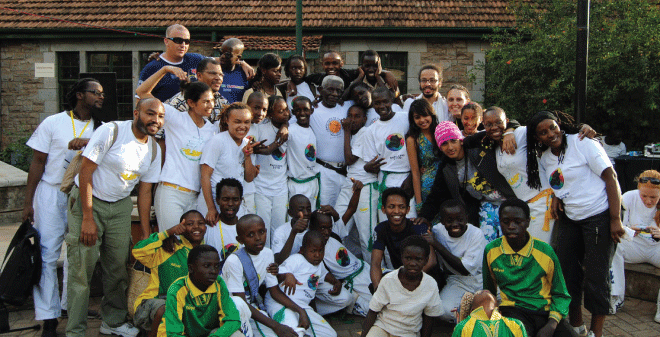
Tandawazi,’ stands for ‘limitless’ in Swahili and is a one of a kind event on Nairobi’s social scene. Embrace yourself for an exhilarating combination of dance, music and martial arts, at this year’s edition, which will be at the National Museum of Kenya on December1st. One of the highlights at the festival is the Brazilian dance and martial arts form, Capoeira, with global masters of the art bracing themselves to showcase skill and finesse before a multicultural gathering. Of Afro-Caribbean origins, Capoeira is a graceful blend of dance, music and martial arts.
African slaves in Brazilian and Caribbean plantations practised Capoiera for entertainment and self-defence starting from the 16th century onwards. Participants sing and play instruments while those on stage respond in agile combinations of acrobatic stunts and martial arts. Brian Owango, the event facilitator is also a dance instructor and Capoeira tutor in Huruma, Nairobi. “The beauty of Capoiera in Kenya is that it cuts across social classes and ages. Children living in slums as well as corporates attend my classes,” says Brian who uses a car garage as his classroom. “Tandawazi,” he clarifies, “is not a charity event but an empowerment initiative.”
The event aims at raising funds for Project Baraza; to build and refurbish community youth centres in under privileged neighbourhoods. He considers this a means of fostering self-reliance. “I keep fit, busy and get entertained by Capoeira,” attests Ayub D’Coasta, a Dandora resident. “Capoeira has become my way of life. Besides acrobatics, I also used to teach dancing at Hillcrest School and got income thanks to Capoeira classes,” he enthuses. Kenyan art forms, Owango says, are increasingly dependent on corporate recognition. “If they [corporates] keep giving art the nod as they are now, then arts will go places.”
He mentions Kenya Airways having engaged Capoeira performers at the launch of their maiden direct flight to Angola on August 17th 2010. Previous support has also come from the Brazilian Embassy, Heineken, Java House and Absolut Vodka among others. Brian Owango looks up to the Edinburgh Festival Fringe in Scotland (largest world arts festival) and aims to model Tandawazi after it. Great acts expected at the festival are; Mestre Ediandro, Capoeira master from Banzo de Senzala Barcelona, Spain, Jody Schroeder, expert dancer from London and Gabriel Limaverde, Brazilian Berimbau (musical bow) maker.
Afro-Indian fusion will witness classical Indian dancer Vishaka Shah getting down with contemporary dancers, drummers and a dhol player to deliver exciting music promoting coexistence. From the Kenyan front we will see songstress Kaz leading Kenyan divas in a blazing concert that will rock the party. Chalo T, Wakake, The Slum Drummers and Shabani Musyoka will also shower us with a percussion avalanche. Tandawazi Coastal versions are also held in Malindi in April covering cuisine sampling, fashion and art experiences. Proceeds from this event will specifically go towards building a dance studio in Huruma. “Empowerment,” says Owango, “is what the young people need to avoid the vicious cycle depicted in the film, Nairobi Half Life which, unfortunately is the reality here.” To exercise your flexibility and expand your horizon, attend a Capoeira workshop at the National Museum prior to the festival from 26th to 30th November. Advance tickets retail at kes 800 while door tickets cost kes 1000.
By Mark Namaswa


Painting the Baraza v. Kerubo Saga
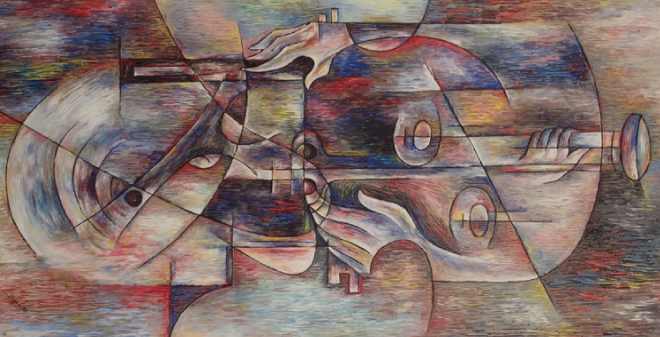
When security guard Rebecca Kerubo publicly accused the now resigned Deputy Chief Justice Nancy Baraza of pinching her nose and wielding a gun at her, she got the country talking. She also inspired the Congolese-born artist, Bezalel Mfashingabo to pick up a paintbrush and attempt to capture the saga from beginning to end. At first glance, the 60 by 80 inch painting reveals nothing of the drama.
It is the label beside the abstract work that offers clues to what story the canvas painting holds. Even then, it would take an elaborate explanation from Bezalel to decipher the many lines within the piece. His ability to capture the “Baraza v. Kerubo” saga without faces and actual images reveals the intricate and mysterious nature of abstract art. At the very top is the image of a rungu (club) that symbolizes authority or power in Africa.
According to Bezalel, the rungu represents the authority that was granted to Nancy Baraza upon her appointment as Kenya’s first deputy chief justice. Her hand seems to be wrapped around the rungu but not quite, which according to Bezalel, indicates Baraza’s inability to handle the power bestowed upon her. Below the rungu one notices a pair of eyes, but a closer look reveals them to be symbols representing the female gender. The pair represents the two women and the unfortunate circumstances in which they met.
Right below the symbols, we see a pair of nostrils. From the left side of the painting, Kerubo stretches out her detection gadget to search Baraza’s effects while Baraza’s hand protrudes from the right to pinch Kerubo’s nose. Below the nose, the barrel of a gun emerges, a forefinger wrapped around the gun’s trigger. The painting concludes with a depiction of the scales of justice, an indication of the judicial process that follows the incident. For Bezalel however, the scales depict his desire to see the law establish equity and equality for all.
By Ann Gitari
Nairobi’s coolest new designers
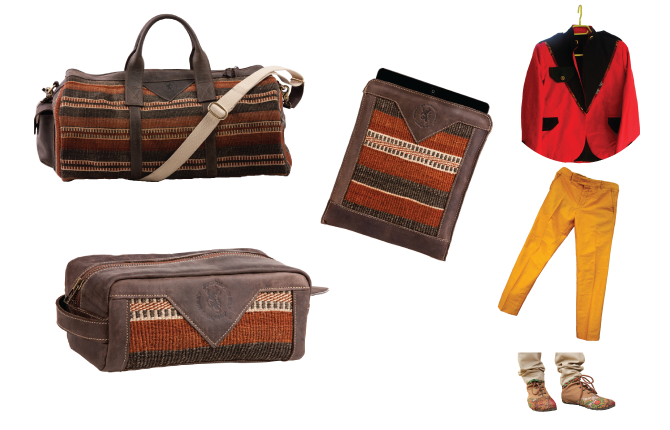
The Internet is abuzz with Jamhuri Wear’s new BUYU line. A kiondo weekender duffle, a soft iPad case, and a pouch with natural tan leather trimmings— these are some of the products in a line that hopes to represent the perfect African-inspired fashion accessories. Founder and Head Designer Jeffery Kimathi told Heritage1960.com (an e-commerce website selling the line exclusively), “We are proud to haveevolved, design-wise, an everyday cultural piece that our mothers, sisters and women for generations have used to carry market produce in.
We transformed a bulky tote into a premium, high-end product that can function in a modern context. We’re so proud to share this worldwide.” Chico Leco (a local retail fashion website) recognises that competition is fierce and staying in business means having fresh products. Sunny Dolat, stylist and co-founder of chicoleco.com, posits, “In fashion, product design is key.” When picking outfits and accessories for Chico Leco, Sunny says that they have to have a mass appeal. It has to have that “it” factor. “It is important that the product is not too common, to give the site an edge over everyone else,” he states. The newest merchandise on the site includes cigarette pants, snoods and vintage brooches.
“Marketing is to get the people interested, but the work has to be good or else three months down the line, people will be talking trash about your products,” says Sunny. That’s what Dishol-House of Design hopes to avoid. Launching this October during the Kitenge Festival, the new player in the fashion industry intends to “reinvent Kenyan design, making it available to the masses at affordable rates.” Dishol will carry Kenyan-made men’s and women’s collections that offer both casual and formal wear. “We’ll have everything, including shoes! The brand is all about meeting entire lifestyle needs,” explains Muthoni Maingi, head of marketing. Their business model is primarily based on selling directly to retailers so they are not planning to have a flagship store. However, after the October 20th launch, customers can view Dishol products at www.dishol.co.ke.
By Mwikali Matata
Advertising As An Art Form
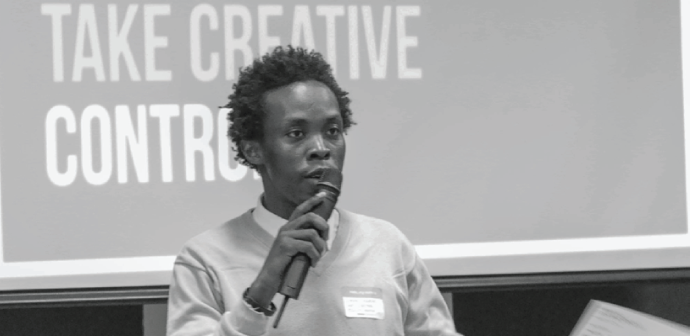
Many graphic designers in Nairobi go straight from art school into the world of advertising, and the transition from art student to commercial crusader is not always easy. Omondi Abudho is an experienced art director and has worked in many of the major advertising agencies (Creative Edge, Ogilvy, the Brand Wagon) in Nairobi. UP met with him for a talk about the art in advertising—and the future of Nairobi’s graphic designers. Omondi has come a long way since his first brush strokes in design school.
Educated at the Buru Buru Institute of Fine Arts of Design, he did not touch any computer-based graphic design tools before he ventured into his first internship at the Nation Media Group. “I had to learn the trade from scratch when I came out of school. In Buru Buru, they don’t really teach you on computers. If you do a poster, you draw it by hand, and then you paint it. It teaches you to think in a minimalistic way. You think the concept through before you execute it. But you are very much behind when you get your first job,” he says. Omonidi values his education, but sees a clear disconnect between the classic skills he was taught in school and the practical skills it requires to work at an advertising agency. But it is not only the skillset that needs to be developed when a young art student enters the hallways of an agency. They are immediately faced with an even bigger challenge—the client.
“One of the hardest things can be to take direction from the client. Sometimes they want to dictate the output in a big way,” Omondi admits. “They want a font that looks like something from the 19th century, they want the logo to be bigger, or they want to cram as much text into the page as possible. They don’t believe in white space. They think the more, the better.” A firm believer in minimalism, this art director sometimes finds it hard to compromise in order to meet clients’ wishes. But Omondi also admits that finding the balance between artistic expression and what the client really wants is where the true art lies in his trade. “What defines creativity is taking the brief from the client and still delivering something artistic. Then you have it. You should be able to give them what they want and still maintain the creative edge. In a holistic way that is how creativity is defined,” he elaborates.
Frustrated over his own education, Omondi has decided to pave the way for a new generation of graphic designers by bridging the gap between art school and the agency mentality. “We want to identify people from college, place them in an internship, and give them a mentor. The transition between doing things manually and on computer is very hard,” he explains. An initiative, created from sessions held by the Art Directors and Copywriters Group (ADCG), gives constructive criticism on members’ portfolios in order to raise the overall bar within the industry. An industry, Omondi believes, that is still hung up on creating ads which are driven by the use of a big image and some text. In other words, advertising that doesn’t prioritize creative expression. For Omondi, the meetings with the ADCG are about driving the development of graphic design and innovation in Niarobi, and, in the process giving a helping hand to some of the new up-and-coming designers. “Things are going to change. The future of graphic design lies in traineeships. We want to promote that.”
Jakob Nielsen
Real Life as Art

A woman with her hand down a man’s trousers is not commonly considered a theme for fine art. But in Nairobi, real life is art, and artist Michael Soi paints it as he sees it. “I have lived in Nairobi all my life,” says Real Life as Art Michael, who once considered joining the military but chose art school instead. “This and that goes on in this city, and people are selective on what they want to talk about.
I try to talk about everything.” Lately, Soi’s work has centered around an extensive series on strip clubs and ART prostitution. With the objectivity and humor he brings to his art, Michael is able not just to humanize Kenya’s evercontroversial sex workers, but also to underscore the other players in the sex trade—the clients. In his paintings, he explores the stereotypes around the women who work the clubs and the streets, and the customers who support their trade. “There’s a lot of denial around these establishments,” Michael says of Nairobi’s strip clubs.
It’s certainly not a side of Nairobi that many people are keen to acknowledge, much less capture in art. But Soi has never avoided controversy. His popular “FAT CATS” series demonstrates how greed continues to impede political, social and economic development in Kenya, portraying politicians as selfish cats and greedy pigs. It was a critical success in this country and beyond. As a man whose dream is a world “full of people who tell the truth and live by it,” Michael’s no-holds-barred portrayal of Nairobi’s social-political dynamics has paid off.
His work is part of public collections in Europe and has been purchased by private collectors around the world. Even Luis Moreno Ocampo (head lawyer at the International Criminal Court) owns a Michael Soi original. But according to the artist, this is still only the beginning. “The great things are yet to come,” Michael predicts. His next series is a collaboration with another young artist: his four-year-old daughter, Malli. “I’m learning a lot from her. I totally love it. We don’t have to worry about perspective, form or anything. We do what we want and get away with it.”
By Anena Hansen
LATEST EVENTS
AROUND THE WEB


