Sasa Nairobi
Hosted by Goethe-Institut, contemporary artist Michael Soi presents a series of 17 paintings celebrating women from all over Nairobi, bringing you different takes on the...
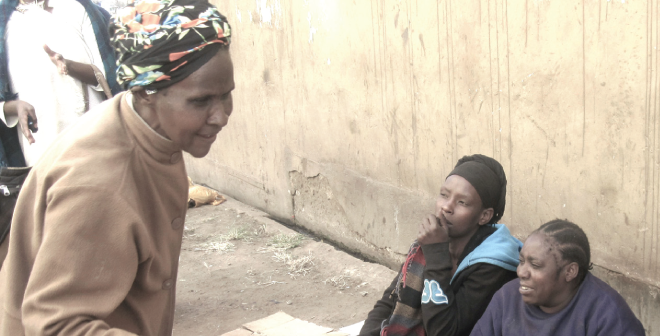
The sight of a woman on the street with her children bundled up outside a popular mall is not a new one in Nairobi. It is also commonplace that when we see a beggar on the street, we often assume that he or she is illiterate, uninformed, poor, or worse, part of some kind of organized begging network like you see in India.
But there’s nothing common about the story of Janet Bett, a former street woman. A trained teacher from Kamwenja Teachers College in Nyeri, she graduated with a P2 certificate for primary teaching in 1977 and taught for 10 years upon completion of her training.
“My life took a turning point in 1987 when I got separated from my husband over a domestic feud. I had six children to fend for. I left my matrimonial home and life became unceasingly difficult at my mother’s, so I decided to look for greener pastures in Nairobi,” Janet remembers.
But life in the big city was far from easy street. Janet found it extremely difficult to secure a job and had no relatives to which she could turn. “I resorted to begging,” she admits. “I had to feed my children, so I got initiated into the street life by other families dwelling there.
Janet faced desperation and sexual abuse. Overwhelmed by so many mouths to feed, it seemed impossible that there could be light at the end of the tunnel. But in 1994, Janet met Ingrid Munro, the founder of Jamii Bora, who was rehabilitating street families in a center in Soweto.
Says Ingrid, “We formed a small women’s club of 50. We would save 50 shillings every day and then gather on Saturdays to make a 250-shilling contribution. I wanted to start a loaning system amongst the street families so that they could start small businesses, fending for themselves and no longer begging.”
At this point, Ingrid was rehabilitating families through mentorship and training. “We engaged those on the street by starting with small projects like weaving mats. Then we’d market our wares,” Janet remembers. In time, due to her education, Janet was made head of an outreach programme. Run by 40 social workers, they go into the community to mobilize street families into pursuing a better way of life. Janet has since been able to educate her children, most of whom are now college graduates. “No one can escape poverty by receiving handouts,” she says. “Kenyans should work hard and believe in themselves, as I did.” For more information, please contact Gabriel Kadidi, the Head of Information at Jamii Bora Trust, through his email, This e-mail address is being protected from spambots. You need JavaScript enabled to view it .


There is a certain glamour to being a single parent; or rather, a perceived glamour. On daytime talk shows, we see episodes where teenagers as young as thirteen are keen on having babies, because they think it’s like having a Barbie doll. What they forget is that “doll” also cries, pees, poops and refuses to sleep all night. So how is it really for single parents, down home in the trenches?
Certainly, being a parent is one of the most difficult yet rewarding jobs on earth. It can also make one turn prematurely grey, go completely mad or want to run down the street, stark naked.
Angeline* was unmarried and in college when she conceived. Every morning at 5:00 a.m., she had to wake up to arrive at school on time. Not only that, but since the baby, hungry and wet, also woke up then, she had to spend the pre-dawn hour cleaning and feeding her
bundle of joy. Should the child decide to have insomnia for some reason, Angeline was forced to stay up, too, keeping her company most of the night. Angeline’s most impossible mission? Trying to keep her daughter quiet and from screaming in her ear, all the while fielding complaints from other members of the household. At least, the young mother, if she wasn’t single and was living with the baby’s father, she would have someone to glare at should he complain about the noise his baby was making!
Household help for single mothers can be a nightmare when there is a baby involved. Many ayahs or housemaids won’t stay for more than three months at a pop, unless one is very lucky. At least, that was Wanjiku’s* experience. She confessed to going through six house helps in the space of just 12 weeks. They seemed to be in a one-upmanship competition, with the first eating her out of house and home (so much so that her food budget doubled).
Considering that Wanjiku’s household was operating on a single income—and babies are, God help them, the proverbial money pit—she found she could no longer afford to keep the ravenous nanny.
No sooner was this young girl out of Wanjiku’s home than the neighbours came calling to congratulate the single mother on tossing her out. Why? Because the ayah had been busy wooing the askari with Wanjiku’s food. Sure, the way to a man’s heart may be through his stomach, but our heroine was not in the business of facilitating such a romance. She had a baby on board! Priorities, girlfriend, please.
And what about the dance of romance? Frankly, all the evidence suggests that dating and single motherhood just don’t mix. The logistics alone are mindboggling. Junior is waiting with bated breath for his mama to come home, ready to pounce. In the meantime, the boss wants to squeeze every last ounce of productivity from her. Between exhaustion, grueling hours and parenting, dating gets left by the wayside. Way by the wayside.
And should Mama Mia happen, just by chance, to come across someone who is willing to put up with all these shenanigans, then there is the challenge of getting the relationship with Prince Charming to gel with Junior. At what point, exactly, should a single mom introduce the man of the hour to her little darling?
Karen* always manages to make sure her son is at a sleepover when she has her own sleepovers. Still, its nerve wracking because kids are like Dobermans; they can sniff out anything...and everything. Karen prepares for that and a host of other kiddie tricks. She conducts a thorough inspection of the premises the morning after her date to make sure nothing incriminating remains. Still, when her son comes back and asks how her night was, she always feels a cold sweat break out on her brow, wondering why he’s looking at her so suspiciously. Like Caesar’s wife, she prefers to appear beyond reproach.
Keeping up appearances just might be the antidote to one aspect of single motherhood, the dating game. But our hats come off to all mothers who have hung in there in the high stakes of bringing up baby. Especially, if you’ve done it on your own.
*Names have been changed to protect identities.

It’s 9.30 a.m. Friday morning. Today, I take a different path than I would normally, one that leads me to a group of individuals that most of society would consider ‘dangerous’. As I arrive at the Nairobi West Prison Facility for Men, the stark sight of inmates clad in striped white-and-black uniforms, engaged in hard labor greets me coldly in the face. Under the hawk-eye gaze of the prison guards, they are tilling tirelessly at the nearby farm. Others diligently prune bougainvillea bushes scattered throughout the grounds. To the inmates, I imagine, this is just normal—a hive of activities in which they are condemned worker bees.
Another bunch of inmates are pruning the hedges of the healthy bush of bougainvillea that’s situated near my destination, the prison’s multi-purpose hall. With an invisible wall made of wire netting, the hall is situated right in the heart of the bustling prison yard. It serves whatever need is thrown on its face, easilytransforming from a church to a recreational space to a town hall meet. Today, it is an artsy space for the training program dubbed, Music Behind Bars, with a group of 15 inmates in attendance—all of them dancing to their own beats as a radio blares.
As soon as Kelvin Koprono (a.k.a. Insect) and I enter the hall, the music and dancing come to a standstill. The men welcome us with a quick kugota. This formality – clenched fists bumping against each other – appears to be the common form of greeting in the prison. Sporting huge headphones around his neck, the fivefoot- two-inch tall and twenty-two- year old ‘Insect’ is myguide to Nairobi West Prison He’s also the facilitator for Music Behind Bars, sponsored by the Kenyan record label Penya Africa. Initiated at Nairobi West Prison about 19 months ago, the program aims to assist inmates in their rehabilitation by using music and poetry to build basic skills such as confidence, public speaking and self-expression.
“I believe that prisoners are people too, and my work is to make them feel. That’s the reason why Penya Africa initiated this project,” says Insect. He stipulates further that a person’s love for art and expression is essential for joining the group. Here, the prisoners affectionately refer to Insect as “teacher”. A budding rapper, he has just released his debut single, Back to Basics. Performing on stage is Insect’s passion, but he is also dedicated to today’s audience of aspiring musicians. After pulling a couple of benches close to form a little circle with Insect in our midst, a prayer is conducted by one of the inmates right before the weekly session starts. And then, the moment I’ve been waiting for: the men, many of them as colorful as their nicknames, begin to pick their instruments.
A musician by profession, the vocals of the towering Mkubwa (Swahili for big) are soft and soulful, beautifully intertwined with his skillful guitar playing. “I was distraught,” he confesses, “to even think about a day without what I love to do, but Music Behind Bars has given me a chance to play the guitar while incarcerated. And to practice my passion: singing.” As Mkubwa strums the guitar the only rapper in the group, Chinoxx, steps in with his rhyme, “Asubuhi kumekucha, kila moja na birika zao, umepata umekosa haya jua yote ndio maisha” (“It’s dawn and everyone has to carry their kettle. If you fail or succeed in your quest, in the end it’s just life”).
Behind this inspirational composition is a man hardcore in appearance, but one who packs a lyrical punch; his streetwise rhyming would make a good hip hop track. Chinoxx is a self confessed gangster. “I was convicted for robbery. Being banished here must have been God’s plan so I could discover my remedy, which is my talent in rapping,” he says. Chinnox adds that he plans to exploit this new-found talent after doing his time. “Some inmates who aren’t with this program call us ‘Ma- smarter’ (the know it alls). They criticize us because they can’t handle our level of discipline. Just like any job around here, Music Behind Bars is demanding. Before being sentenced here, I was just a businessman who would never embrace any form of art. Now I am the dance instructor. I can even play a few strings
on the guitar,” says the larger-than-life Big Daddy. Andy and Kamau perform an excerpt from their joint poem titled “Lost Freedom”. “The day I was arrested, my mind never rested. I was breaking the law, now I have to break the bad habit… ” Andy testifies that Music Behind Bars has made him learn what it means to simply appreciate life. “I hated my existence and people because I was framed for fraud. I never committed any crime,” he remarks, teary eyed. “Insect turned the junk in me into a jewel. After several classes I realized that poetry has power to change the world.” Adds manager Natalie Nukkenaer, who works with Penya Africa’s Founder, Nynke Nauta, “We have decided to reach out to the prisoners for as long as they are in jail. And, if we meet someone with extreme talent, we encourage them to audition at our music school, the Sauti Academy, upon release.”
Penya Africa also runs other initiatives, including Tung’are, a Swahili word that means to shine. Focused on reforming street boys in Kangemi, Insect visits the young group every Wednesday. “Our main focus is to use music to sensitize the boys on the issue of drug abuse,” he says. It’s encouraging that record labels are now carrying the music torch that much further, embracing boys and men who may have been marginalized by society but are still seeking to express themselves. “I have to admit that my job is quite challenging. However, only one thing has kept me at it -- the few inmates who have called to thank me after their release, or to ask for advice on how to advance on their talents,” concludes Insect with a knowing smile.

My boss, a dyed-in-the wool journalist, likes to tell stories—tales of journalistic valor, frontline madness and gonzo adventures. Mostly we are entertained and very often baffled. Recently he told us about the movie,“The Network. You haven’t heard of this movie because it was released in 1976. In fact, nobody in the editorial meeting he was chairing had heard of that movie, because nobody had been born then. The movie is about a television newscaster, Howard Beale—a character beleaguered by slipping ratings and a new, corporation-driven society who wants him out of a job. To show his frustrations, he goes on air and calls his impending dismissal, “bullshit”.He is then forced to apologize on air by the suits upstairs; instead, he goes back on the set and kicks-off more vitriol.
He manages to galvanize the nation by persuading Americans to shout the phrase, “I’m mad as hell and I’m not going to take this anymore”, out of their windows during a lightning storm. Ironically, his ratings soar and he manages to save his job. The lesson? ‘The Man’ is spineless in the face of true people power. (Never mind that Howard loses his soul in the process). The Network is a movie about how we don’t have to take injustice lying down; how we, when pushed to the wall by the system, should stand up and shout, “I’m mad as hell and I’m not going to take this anymore!”
Kenyans said this to oust the former Moi government. And they’re saying it again ahead of 2012. And I guess we’ll keep saying it, until we get it right. The old ways of doing things around here that involved intimidation, terror and thuggery are over. Otherwise, ‘say hello to my lil’ friend’ (I know you know that line). Oh, and he’s called The Hague. In this issue, we honor late laureate, Wangari Maathai—one of the most remarkable women of our time. She said she was ‘mad as hell’ when the system tried to stifle her dreams of a greener world. Though the war for public space and lands still rages, she has won many battles on its front lines.
And even closer to us, at Mondeas, we are of the mind to tell off the twisted system that sent a bunch of thugs to turn our offices upside down. We won’t take it anymore! (But much more on this in the next issue.) Meanwhile, we also tackle the issue of infertility and how young women in Nairobi are increasingly finding it hard to conceive. We also round up a few television and media personalities and ask them, “What is this whole Reality TV hype all about?” “Is there really life after your 15 minutes are over?”
You will also find your usualculture and arts regulars in this issue. Oh, please remember to participate in our competitions: Victoria Furnitures WIN A COUCH and our WIN A CASE OF LELESHWA WINE before they wrap up. Details are on our website www.upnairobi.com. I don’t know about you, but I’m going to look for this “Network” movie to get a bit more inspiration to fight the powers, and hope, at least, that it’s not in black and white. Happy reading, folks. Biko
Before I add my voice to the many others who have been talking about the remarkable achievements of Wangari Maathai , I think I might let her do the talking. In the film Dirt ,she tells the tale of the hummingbird. She tells us that deep in the jungle, a fire is burning, and the fire has shocked the animals. So much so, that they all stand there, eyes wide doing nothing. All of them, that is, except for the hummingbird. The hummingbird is busily filling his little beak with water and flying back and forth splashing his tiny contribution on to the raging fire. The other animals ask why he is bothering, he is so little and what difference is he going to make… To which the hummingbird replies, “I am doing the best I can.”
It is hard not to sound sycophantic and repetitive, while all the world’s voices echo the same sentiments, but Wangari Maathai was an exceptional person. Standing up for what she believed in, regardless of risks, made her a noteworthy individual. Receiving international accolade, especially a Nobel Peace, put her in a pretty extraordinary bracket. But when you combine this with personal achievements including being the first woman in east and central Africa to be awarded a PhD, and social achievements, such as empowering a generation of Kenyan women, oh and not forgetting that small issue of fighting against injustice on a national level, well, then you have a rather special definition of ‘exceptional’ reserved for Wangari Maathai. For anyone who hasn’t read her autobiography, “Unbowed”, go out and read it, now. Let that be how you first honour her memory. It is essential you do, because it may well change your life. If not for any other reason, then to just see a woman so stubbornly determined that threats, beatings and even tear gas couldn’t stop her.
Although it might seem glamorous to win a Nobel Peace Prize, there is nothing glamorous about how she got there, and public opinion was not always on her side. Her name was dragged through the mud, her husband abandoned her for being too hard to control, and she was often destitute and on the run. It is a story of struggle. But what makes it incredible is that it is a chosen struggle. When people asked for her help she always chose to accept. Nowhere is this better illustrated than her joining the elderly mothers of political prisoners in 1992, striking at Freedom Corner. They were savagely attacked: stripped, gassed and beaten; Maathai spent a week in hospital, as a result.
However, it is quite rightly environmental campaigns that she is best known for. She saved Uhuru Park from the Times Media Trust business complex, and she saved Karura Forest from encroaching developments; most notably, she started The Green Belt Movement. This empowered, firstly women, then everyone else, to improve their lives by going back to nature and going back to a culture that understood the symbiosis between humans and ‘the land’. The benefits of planting trees were manifold: supplying firewood, and material for building and stabilizing the soil to improve agriculture and preventing soil erosion, which helps to maintain biodiversity and conserve water. Trees were the roots of everything for her; they were the beginnings of her pro-democracy movement, and she saw that trees were also the future.
It is with this in mind that we have to look at what happens next. I have had the inspiring job of looking at the next generation of Kenyans fighting the good fight in ways, which would make Wangari proud. I have had the pleasure of meeting Raabia Hawa, the animal’s champion. She is an honorary KWS warden who spends her free time de-snaring parks and campaigning for animal rights. We don’t need another hero but we do need a lot more hummingbirds. Isabella Monson is a freelance writer living in Nairobi and loving it


