Sasa Nairobi
Hosted by Goethe-Institut, contemporary artist Michael Soi presents a series of 17 paintings celebrating women from all over Nairobi, bringing you different takes on the...

The term “starving artist” could aptly describe many recording artists across Kenya and the greater East- African region. This is due, in part, to music piracy, a thriving business that continues to rob musicians of their expected earnings. According to Robert Sigei, legal counsel for the Kenya Copyright Board, piracy is an estimated KES 4 billion industry, one that stakeholders have fought hard to remedy but with very little success.


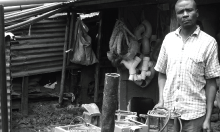
Innovation and entrepreneurship is often mentioned as the driving force of Kenya’s economic growth, and inventions like mPesa are seen as the poster child of this development. But in the informal settlements, innovative entrepreneurs are driving their own development. Here, necessity is more than ever proving to be the mother of invention.
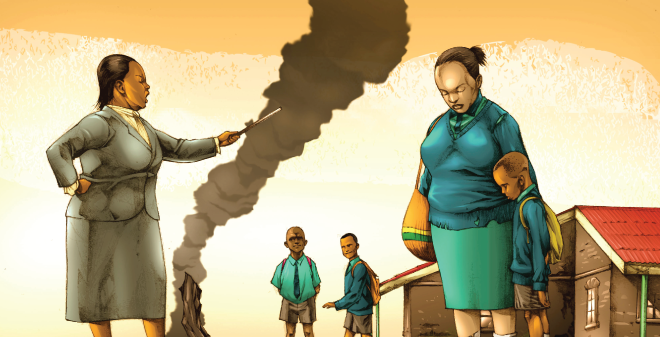
A thin film of chalk dust has settled on the first row of tabes in the science laboratory on the ground floor. Wooden stools rest their thin metallic legs here and there across the cement floor; more are marooned at the end of the room, upturned, legs stabbing at the ceiling.
The escapades of King Herod, Prophet Elijah and sheep, both in the literal and Biblical sense, are frozen in time on the reying blackboard, echoing lessons of a class long dismissed. Here is where I set up to interview Mary*. The 45 year-old public school teacher carefully chooses her stool, swapping a tall wobbly one for a short sturdy one. It seems grounded and dependable, just like her. Mary has devoted close to 19 years of her service to a public school located in one of Nairobi’s bustling residential areas.
A lot has changed during these last two decades where Mary has served as a teacher. Perhaps the biggest change of all was the introduction of free primary education (FPE) in 2003. It gave many disadvantaged kids an opportunity they never had before. However, Mary has noted an obvious change in the dynamics of pupil enrollment at the school where she works. Most of the pupils used to come from high- to middle-class homes. Now, they are mostly middle- to low-income generating families.
“This affects how the children perform and even behave. In the first term, the bright ones are often afraid to shine. Nobody wants to be called a chopi (bright know-it-all),” Mary says. This is emblematic of a vicious circle that drives some of the financially-stronger students away from the public schools. Dr. Willis Otengah, a sociologist at Kenyatta University, points to the falling standards in public schools as the root cause of the flight. “Before free primary education, many parents took their children to reputable public schools in which they had confidence. Now parents are struggling to take to and keep their children in private schools, [and this is] driven by the deteriorating standards and performance in public schools,” he says.
Leila Ambetsa, a mother of three, echoes these sentiments, going on to add that because there are too many children in the class, the teachers often fail to concentrate on the pupils. “During school holidays, my nephew [an 11-year-old who attends a public school] is never assigned homework. And when I compare his handwriting to my daughter’s [seven-year-old who attends a private school], hers is much better,” she says.
Is this just a mother’s favoritism over her own child? Not according to the 2008 African Population and Health Research Center (APHRC) paper on “Factors Associated with Low Achievement Among Students from Nairobi’s Urban Informal Neighborhoods”. The paper reveals that students in public schools score up to 48.3 fewer points than their peers in private informal schools.
Undoubtedly, the growing pressure on the public schools is starting to translate into a bigger gap between those who can afford a private school and those who can’t. When the KCPE results were announced earlier this year, over 55 percent of the graduating pupils failed to meet the entry grade to secondary school. This was followed by the discouraging reports of several pupils committing suicide after their hopes and dreams of escaping poverty through academic achievement were shattered.
One of the main challenges that public schools face is overcrowding in the classrooms. The average student to teacher ratio is now one to 45. A matter that Doreen, another public school teacher and administrator, believes has dramatically lowered performance standards. She feels that the Ministry of Education should be charged with the responsibility of levelling public and private education in such a way that individuals from the two are not so different from each other.
William Migwi, Principal Economist at the Ministry of Education, Management Information Systems, acknowledges that the ministry has to play its part, but that an increase in the number of teachers is only part of the solution. He says, “It may by employment of more teachers. Yes, the free primary education brought more students who need more teachers and KNUT (Kenya National Union of Teachers) is also looking to have more teachers employed. However, this problem is not necessarily because we have fewer teachers. Actual learning does not take place because a teacher has been posted somewhere. There are other factors involved. Is the teacher useful? Is he attending his classes? Does he or she have the required commitment? Do they have the necessary resources, both personal and otherwise? Are they being supervised in the right manner?”
So, do privately educated individuals stand a better chance at success beyond the classroom? Lina tends to agree. She’s been a teacher and head of a prep section in a renowned international school in Nairobi for 15 years. Lina states that privately-educated individuals stand out more—and are more competitive compared to their publicly-educated counterparts. Nonetheless, she strongly feels that the social divide between the private and public education sector can be bridged through teacher training programs. That is why Lina has created a program that aims to have teachers improve their teaching methodology in a way that will incorporate international standards and mould children into well-rounded individuals.“Teachers can be trained and empowered and, in turn, empower children right from their early stages,” she says. “There’s a lot that can be done. We do not have to wait for the government to intervene.”
And many teachers don’t. Mary is doing her part to bridge the gap between her students. At the close of the interview, pupils are starting to gather in the science laboratory for a “Life Skills” class. “Thankfully, children are flexible and have no boundaries. They get better as they move along,” Mary insists, hopefully.
*Not her real name.

Simon Munga was born into a poor family with a farmer dad and a sickly mom. Most of his father’s meagre income went towards meeting his mother’s medical costs and feeding the large family. For Simon, going to an elite school seemed like an unlikely dream, but his innate intelligence and personal drive earned him a place at Starehe Boys School—an event that completely changed the trajectory of his life.
Starehe Boys School is a place that values merit over money, and because many of the brilliant students at the school are unable to meet the cost of the education, they are fully sponsored by the institution. The Kenyan government provides roughly 40 percent of the school’s funds, and the rest of the budget comes from school fees and donations. Consequently, Starehe is not only a school for the needy. As Principal Paul Mugo points out: “We also have boys from other backgrounds, and some of them are well to do. When needy kids come here, they quickly realize that any disadvantages they have can be easily wiped out with hard work, and this is a great boost to their self-esteem.”
For Simon, that boost of confidence was just what he needed to develop his academic abilities. “When I came to Starehe, I was very meek and shy. I feared everyone. I was encouraged to work hard in class, as well as interact with others. Then I was made a prefect. Being entrusted with that role showed me that I had leadership qualities. It changed me completely,”he says. Nestled between the open-air Kariokor Market and a maternity hospital, Starehe is hardly the place from which you would expect academic giants to emerge. Yet for the past 60 years, the school has produced crop after crop of brilliant young men, including notables such as Former Assistant Minister Rapahel Tuju and Kinuthia Murugu, Permanent Secretary inistry of Youth and Sports.
To Principal Mugo, the Starehe experience is about a lot more than just academic excellence. His goal is to teach the children duty, discipline and service—skills that enable them to reach even greater heights in the classroom, as well as in life. Service to the community is taught through the school’s Voluntary Service Program (VSP), which students take part in at various points of their academic journey. VSP lets the students experience the value of community service and hard labour by sending them out as volunteers in places like health clinics and factories. It is through this program that a former student at Starehe, Videlis Kamoni, found his calling.
Videlis, now a medical representative with international medical giant Novartis Group, says the VSP is what convinced him to pursue the career he is in today. “During my time at Starehe, I took part in the VSP twice, during my school holidays— once at a community clinic and then at a factory. Working at the clinic really opened my eyes to the real world. I saw real people, who were ill and needed help. I got a chance to work with them. In the end, that experience really nfluenced my decision to study Biochemistry at Moi University,” he says. Another “old boy”, Standard Business reporter Morris Aaron, attended Starehe as a sponsored student. He says his time there taught him the value of hard work and instilled in him a work ethic that resonates in his career, even today.
“All the boys, there were remarkably intelligent and there was always lots of healthy competition. In fact, just one mark could make the difference between you being number five and number 15. So, you couldn’t just sit back because you were clever. We had to work really hard and study. That instilled a good work ethic and perseverance in all of us.”
A closer look at Starehe’s history helps one better understand why discipline and hard work are core values. It was founded in a dark period in Kenyan history, when the Mau Mau waged a guerilla war to gain independence from Kenya’s colonial occupier. Their slogan at the time was “Mzungu arudi ulaya, mwafrika apate uhuru”, meaning, “White man, go home, let the black man be free.” However, the founding fathers of Starehe remained either deaf or indifferent to this slogan, as they came together—one white and two black men—to open a rescue centre for orphans.
Now, six decades and numerous benefactors later, the school has managed to preserve the values on which it was founded. Simon tells me, with a huge grin, that he is optimistic about the future. He reveals that he is about to complete a subsidized diploma program in IT at Starehe Boys College—and that he has also been accepted to university to study economics. “I am sure,” he insists, “ that what I have gained at Starehe will help me change the face of my family in a few years.”
As I drive out of Starehe, I can’t help but equate the teachers at Starehe to the alchemist. An ancient scientist, bending over his worktable, brewing a protoscientific stew of chemistry, metallurgy and physics to turn a block of lead into pure refined gold. Because, in its own way, that’s exactly what Starehe is doing. It’s an institution that takes needy boys, creates a stable, structured environment for them, and equips them with the skills and the opportunities to create a better life for themselves and their families.
I leave the school feeling as though I have seen a glimpse of greatness—no blinding lights, no vestiges of grandstanding, just the Wonder Boys and teachers of Starehe.
For more information on Starehe Boys Centre, email info@ stareheboyscentre.ac.ke, call +254 020 6761 221 or visit www.stareheboyscentre.ac.ke
In July 2011, President Mwai Kibaki launched the Kenya Open Data Initiative (KODI) as a single online portal through which key government data would be freely available to the public. This put Kenya on the map as the first developing (and Sub-Saharan African) country with an open government data website.


