Sasa Nairobi
Hosted by Goethe-Institut, contemporary artist Michael Soi presents a series of 17 paintings celebrating women from all over Nairobi, bringing you different takes on the...

Of the approximately 120,000 Kenya Certificate of Secondary Education (KCSE) candidates who qualify to join public university each year, less than 25% gain entry. And with job opportunities being few and far between (most needing college or university papers) the future seems bleak for those who fail to gain entry.
Enter Kenya’s immersion in andnewly-found emphasis on eLearning. By emulating a classroom setup with interactive lectures, quizzes and library access, these virtual-education portals are increasing the opportunities for higher learning. In the last 10 years, traditional universities such as Kenyatta, CUEA and Maseno have begun to partner with international universities and organizations to introduce eLearning courses on and off campus. Still, it is veteran institutions, such as the African Virtual University (AVU), who are setting the pace.
Established in 1997, AVU is an intergovernmental organization that currently operates in 14 African states (including Kenya). Chiefly offering courses in Mathematics and Science, the university started as a “reaction to the lack of quality teachers in these fields,” explains Senior ICT Officer Declan Ottaro, during a recent demonstration class offered this July. UP was among the group of participants taken through the motions of a typical AVU classroom session. In order to “attend” a virtual class, students need a stable Internet connection for at least two hours (classes are typically one hour or more), a computing device and a headset.
The most interesting part of the demonstration was using the web conferencing program, Elluminate Live! As we tested and fiddled with the application, we were able to chat with one another (also using a plethora of emoticons), scribble notes on the whiteboard available onscreen and call the instructor’s attention by “raising our hands” (there’s a hand icon that flashes to alert the lecturer).
While it made a strong attempt to match up to the traditional classroom, there are obvious shortcomings. This class—or any other such real-time virtual teaching space—requires expensive computing devices accessible over long periods of time. Strangely, fee structures are not available online and calls to AVU offices went unanswered). Also, the use of a mixed mode of delivery that utilizes online and face-to-face training is an extra cost to the students, as they have to travel to partnering institutions on these occasions, as well as at exam times. The number of courses available also pales in comparison to those at a typical university.
That said, eLearning has gone a long way in availing educational opportunities for many of those who’ve been turned away from public universities and cannot afford private ones. (Since its inception 15 years ago, over 40,000 students have been successfully trained in AVU’s Open Distance and eLearning (ODeL) programs.)
One such happy customer is Patricia Mwansa Chileshe, an ICT Basic Skills student. “This course has changed the face of my life. I’m able to do so many things that I struggled to do earlier, like preparing lessons, typing exercises and tests, keeping records of my students and many more other personal things.” So if you are among those who aspire to get that higher degree, these virtual portals might be the solution.



She turned in his direction, because she felt someone staring. When he came over and sat down, she was in awe. He was broad shouldered, in a crisp pair of jeans, a sharp blazer and the perfect smile. They spoke for all of five minutes although she doesn’t quite remember what was said. She reached into her purse totake down his digits, but when she looked up, he was gone. This is how Cheroo Mung’ony describes meeting her current boyfriend. That five-minute, ethereal-sounding encounter two years ago at Nairobi’s Casablanca Bar was her first taste of speed dating. Back then, this style of matchmaking was quite novel, with only a handful of such events taking place in the city. Now it has grown in popularity, attracting between 100 and 400 people per event. So, how does it work? These events are quite the structured affair and often begin with singles meeting up at a social venue. They’ll huddle up in one room with notepads, pens and flat shoes.
The key to these events is music. The volume is turned up, and the singles are released into the fast and furious world of dating. Two singles get five minutes to talk to each other and, when the background music stops, they must each move on to the next single. This happens until everyone in the room has spoken to one another. Because each conversation lasts just a few minutes, a group of 100 singles can have up to 12 dates each in a matter of an hour! Tony Karanja, a speed-dating organizer with Infinite Media, says that speed dating has become an attractive option because it saves time. “Nairobians are the busiest people on earth! And since speed dating cuts out several steps in the dating process, it tends to suit them very well,” he says. “Speed dating is smart dating.
You don’t have to do the guessing you do at a club, wondering if a guy is single or married or gay. Everyone there is single and searching,” explains Faith Gichuki, a speed-dating attendee at Azalea Bar last November. So, is this new form of quickie dating the perfect solution that Kenyan singles have been searching for? David Lebohang is a frequent participant, and he is not so sure. “The problem with speed dating is it’s all about first impressions, and if you mess up in the first few dates, it has a ripple effect and messes up the rest of your evening.” Thankfully, you have the rest of the night and more singles to get through to potentially fix this kind of situation.
Remember, speed dating has gained most, if not all, of its popularity due to its ability to bring together a sizable number of singles. See, in the time it takes to heat up a frozen meal, a buoyant single at a speed- dating event will have sailed through two dates. And, perhaps like Cheroo, you too might make a love connection when trying your odds in the numbers game. To get in touch with Tony Karanja, visit www. infinitemedia.co.ke or www.facebook.com/Speed- datekenya.

Residents of Karen Ngong View Estate are under assault. The seasonal stream in the area that feeds the Mbagathi River has turned into a perennial flow with hundreds of thousands of gallons of raw human effluence. “The stench and visible pollution on our property became so serious that we couldn’t ignore it,” says Lizzie Gilbert, a resident and member of the Karen Ngong View Estate Association, which has started work towards fixing this crisis.
“I worry about the water table, the danger of the pollution on our property, and [for] all those who live and work there.” This pollution, the estate committee asserts, is deliberate. The primary culprits, identified in a call-to arms addressed to the residents of Karen Ngong View, are three schools located above the estate—Maasai Girls and Teachers College, Hekima School and Elirama School—as well as individuals and businesses building on the riverbank. They are accused of piping their sewage wastedirectly into the stream.
Tests done on water collected further downstream bears out this accusation, or at least the accusation that sewage waste is finding its way into the stream. “The water sample had coliform bacteria,” says Dr. Ruth Chunge, a medical parasitologist and the co-director of the Centre for Tropical and Travel Medicine (CTTM). “These bacterial forms are commonly found in animal faeces, but the sample had Escherichia coli (E. coli), which is evidence of human faecal matter.”
Besides E. coli, dangerous levels of protozoa, intestinal parasites and other bacteria were found in the water, which could be responsible for typhoid, cholera, dysentery and a host of other diseases in humans. Officials of Hekima School and Maasai Girls were unreachable for comment, but Mr. Saldera, the principal of Elirama School, was outraged by this accusation. “The investigation wasn’t done very well,” he said. “The vandalized pipe they say is responsible for pollution is not ours. It passes through the school but it belongs to the Ministry of Water.” “We use pit latrines,” added George Kimani, a director of the school, “so that waste cannot be ours.”
Nobody in the direct employ of the Ministry of Water and Irrigation seemed to be aware of this vandalized pipe in the Karen Ngong View area. Instead I was referred to the Athi Waters Services Board (AWSB), a state corporation under the ministry that is directly responsible for the infrastructure that supplies water in Nairobi, and takes away the sewage from our homes. Very apropos, since Mbagathi River is a tributary of Athi River, but they, too, had no knowledge of the broken pipe.
“The drainage systems are old so we rely mostly on physical inspections,” said Joseph Kamau, an engineer with AWSB. “But we are installing more and more detection systems.” But detection isn’t the only problem with old drainage systems. “The City Council of Nairobi has done a good job of cleaning water at the source,” says Dr. Chunge, “but our distribution systems, the pipes, etc., are very old and have so many leaks that the water could very well be contaminated by the time it comes out of the kitchen tap.” It doesn’t help that the sewage system runs parallel to the water distribution system, making contamination that much easier.
Most of the water in Nairobi is, however, contaminated directly (as alleged by the Karen Ngong View Estate Association in their area). The Nairobi sewage system, according to reports by the AWSB, covers about 40 percent of the city, with a smaller percentage of the population actually connected to it. Informal settlements contribute much of the garbage and human waste that pollutes our rivers, due to lack of infrastructure to cater to this need. “This water is fed back to slum residents by private water providers illegally tapping into our systems,” says Mr. Kamau, “but we are working to fix theunderlying problem.” He speaks of the Nairobi Sewerage Improvement Project, a four-year initiative that is part of the Nairobi River Basin Programme, piloted by the government in conjunction with UNEP, UN-Habitat and other stakeholders.
The project seeks to overhaul the sewer system in Nairobi, starting with areas that really need it: “Dagoretti, Kawangware, Kangemi and Githurai, among others.” The project, unfortunately, is still in the evaluation phase and will, more likely than not, take longer than four years to complete—if it even actually gets off the ground. One lives in hope.

It seems that nearly every week, we are held hostage in our very homes. Brown outs, black outs, no electricity, at times for days on end. Plus, in this season of heavy rains, it’s tough to fix any infrastructural issues. And let’s not forget those hefty bills. Is there light at the end of the tunnel for Nairobi and the country at large? Wind.
Lake Turkana Wind Power (LTWP) is harnessing it like never before on the African continent with 365 turbines spread across 40,000 acres. The project will provide citizens with 300 MW of low-cost, reliable, renewable energy, offsetting Kenya’s need to spend over Kes 15 billion per year on importing expensive, unpredictably-priced fossil fuels (diesel). This encouraging news is being delivered by the impeccably-dressed and eloquent Carlo Van Wageningen, chairman of LTWP.
“The wind resource in this part of Africa is huge, making it competitive with other, more traditional forms of power generation like hydro, diesel and geothermal. We are building the single largest wind farm in Sub-Saharan Africa, which will feed into Kenya Power’s national grid to supply approximately 20% of its electricity-generating capacity.”
What’s more, the wind farm has been strategically designed to minimize environmental impact. Its location, 25 kilometres from the shores of Lake Turkana, prevents any intrusion on tourism, while also placing it outside principal migratory routes for birdlife. And, as LTWP is all about green energy, there are no carbon emissions to worry about. Which leads us to carbon credits. “We’ve been approved at the Gold Standard rating by the United Nations Framework Convention on Climate Change,” says the chairman. “As these premium credits possess value on the stock market and can be sold, we estimate a generation of approximately 26 billion Kenya shillings over the 20-year lifespan of the project.”
LTWP will be returning essentially 100 percent of that profit to the government for investment in communities around the power plant, improving their livelihoods through job creation,education, healthcare and more. Another breakthrough: At some $750 million, LTWP represents the single largest private investment in East Africa— perceived by many to be a massive gamble. “A lot of eyes were looking to LTWP to see if it would take off, and we’ve proven that wind power can work here. So we’ve broken that ice. Furthermore,” Carlo elaborates, “the size of this investment will attract like projects in the infrastructural sector, so desperately needed in this part of the world to support a real economic spinoff.” With a financial close expected by the partners in the coming months, LTWP plans to be fully operational at 300 MW by late 2014 For more information, go to www.laketukanawindpower.com.
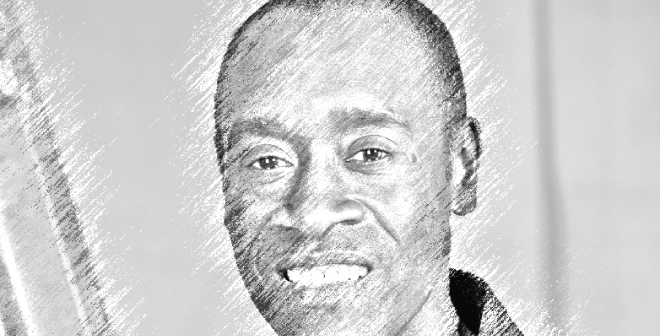
Actor, producer and humanitarian Don Cheadle, best known for his roles in Boogie Nights, Hotel Rwanda, the Ocean’s film series, Crash, Traffic and Iron Man, was appointed two years ago as Goodwill Ambassador for the United Nations Environment Programme (UNEP), headquartered here in Kenya. This month, the Academy Award nominee speaks to UP about why he believes each of us can play a critical role in tipping the scales towards a more sustainable future.
UP: How did you end up as a United Nations Goodwill Ambassador?
DC: Well, when the Secretary-General taps you on the shoulder and requests that you join the ranks of the UN, he may not be Don Corleone, and you may not be in The Godfather, but you do realize that you better not refuse.
UP: What inspired your interest in humanitarian issues?
DC: In 2004, I had the chance to play the lead in Hotel Rwanda, a film about a man
and his family’s plight against genocide.
We received critical acclaim for the film, but more importantly, we attracted the attention of the political community. One thing led to another, and I found myself between Darfur and Capitol Hill, Washington, D.C., raising awareness and trying to influence political will. I realized then the power of a well-told story and its ability to reach across all sorts of divides to deliver a message. I realized that each of us has a role to play.
UP: How did this activism segue to environmental issues?
DC: Seventeen years ago I became a dad and experienced a shift in the matrix that decided that someone other than Don Cheadle would be considered first when it came to the important issues in life. After the birth of my second daughter, I started the inevitable process of projecting into
the future. And as those of us who have kids know that the future starts coming at an alarming rate. I didn’t like what I was seeing. I decided to try and make my life greener, and to use what influence I may have to inspire people to learn more and connect the dots for themselves.
UP: Do you see environmental and humanitarian issues as being separate?
DC: No. If you are a humanitarian you have to be an environmentalist. If we don’t have a healthy, sustainably-managed planet, we will forever be making bad decisions based on oil prices and fighting over limited resources.
UP: What do you see as the most critical
issue we face?
DC: How the planet will be able to sustaina population that is now at seven billion and that will grow to nine billion by 2050, 38 short years away.
UP: World leaders will be gathering in a few weeks at the Rio+20 Conference on Sustainable Development. It has been 20 years since the first Earth Summit took place in Rio. What would you ask our political leaders to consider?
DC: How far we have gotten (or not) in 20 years, and what the world will be like if we keep living as we have done for the last 200 years—with our model of produce, consume and waste. We all need to take part in letting them know that we are ready for a game-changer, the next big
idea.
UP: And what is that?
DC: I think it’s what UNEP calls a Green Economy—an economy that is business, people and planet-centric. It means more jobs and the real possibility for a better future.
UP: Any parting words?
DC: Developing countries like Kenya are already ahead of the game when it comes to greener solutions. So keep it up and do whatever you can. Small things have a big impact when enough people get involved. World Environment Day is a good start. Learn more and join us.
For more information, visit www.unep.org/wed


